
Under the blue lights, discoveries that don't quite explain themselves, even when you think you've found the key. Recent releases from Citizen Above Suspicion, Steven R. Smith, Robot God, Praed, Barbican Estate, Acid Rooster, Soundwire, Blind Yeo, Hyper Tensions, Sphinxes in Paradise, and Bakusui Heaven.
| Time | Artist | Track Title |
|---|---|---|
| 00:46 | Citizen Above Suspicion | Failure |
| 05:43 | Steven R. Smith | Returning To Everything |
| 09:16 | Robot God | Curse of the Driven |
| 16:01 | Praed | Al Hathayan |
| 20:51 | Barbican Estate | Song for Derek |
| 25:25 | Acid Rooster | Time Lapse (Live) |
| 35:52 | Soundwire | These Little Moments |
| 40:16 | Blind Yeo | Memory to the Soil |
| 44:24 | Hyper Tensions | Bad Teeth |
| 47:40 | Sphinxes in Paradise | I Don't Need My Legs Anymore (version 2) |
| 52:02 | Bakusui Heaven | Thermo Optic Camouflage |
2026
2027
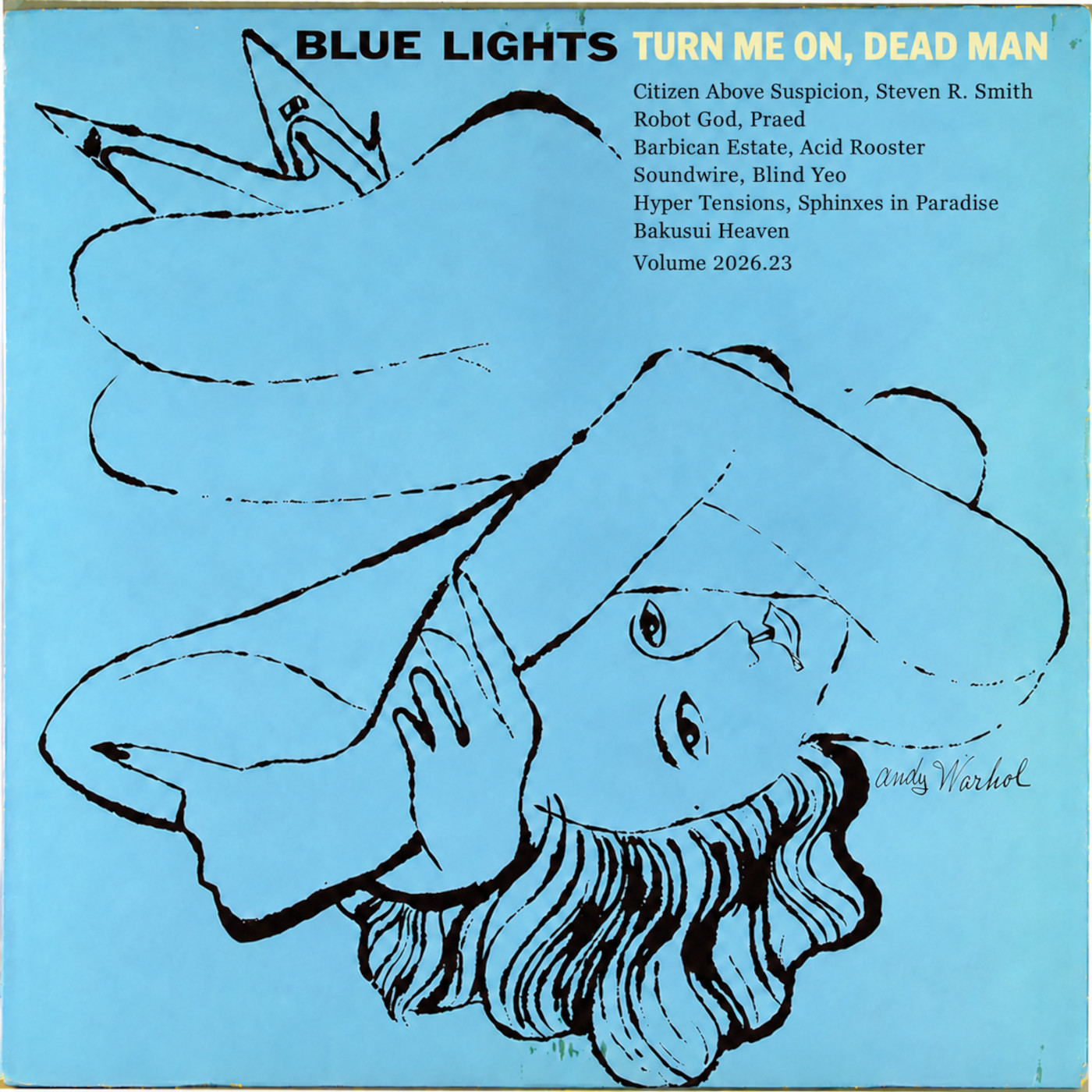
The cover for Blue Lights takes its inspiration from Kenny Burrell's classic Blue Note album, while the audio clips come from Robert Aldrich's 1955 film noir Kiss Me Deadly. In the film, private detective Mike Hammer follows a series of clues that eventually lead him to a mysterious key. Finding what the key opens, however, doesn't necessarily bring him any closer to understanding what he's discovered. There are plenty of mysteries in music, too, and sometimes following an idea wherever it leads is more interesting than knowing the destination in advance.
Literature, film, and landscapes provide inspiration for several of the tracks in this episode. Hyper Tensions draw on John Kennedy Toole's A Confederacy of Dunces for "Bad Teeth," finding uncomfortable parallels between the novel's world and our own. Sphinxes in Paradise bring Anna Akhmatova's poetry into a contemporary setting of psychedelia and trip-hop, while Barbican Estate's "Song for Derek" was inspired by a winter visit to filmmaker Derek Jarman's home at Dungeness. The landscapes of Aotearoa/New Zealand, along with birdsong and other natural sounds, helped shape Bakusui Heaven's A Passport to the Forest. Musical influences are equally varied: Praed draw on Arabic popular music, free jazz, and electronics, while Citizen Above Suspicion explore opposing forces on As Above As Below.
Improvisation and unexpected discoveries are recurring themes in the musicians' accounts of making these recordings. Steven R. Smith took a chance on a battered Spanish guitar and found that songs seemed to emerge from the instrument almost effortlessly; "Returning to Everything" began as an improvisation played with a paintbrush. Robot God have moved toward more structured songwriting without abandoning their improvisational instincts, while Acid Rooster stretch familiar material into new territory during live performances. Blind Yeo's "Memory to the Soil" grew out of an improvised performance at a solstice gathering and continues to evolve each time the band plays it. Soundwire describe how their songs loosen and change through live performance, even as they search for ways to move beyond their familiar influences. Sometimes the most interesting discoveries happen when nobody is quite sure what they're looking for.

Formed in Hackney, London in 2024, Citizen Above Suspicion has quickly established itself through a potent blend of abrasive reverberations, driving new-wave grooves, and hypnotically repetitive psychedelia, delivering a truly immersive sensory experience.
TMODM: “Failure” was one of the first songs you wrote for the album, before the current lineup was fully in place. How much did the song change once Citizen Above Suspicion became a working three-piece?
Citizen Above Suspicion: The song wasn’t very much different, just a lot faster. I would say it was probably 80% written before the band became the band. Then it was more about trying to get a structure that made sense and polishing bits.
TMODM: You describe the album as drawing on ideas of duality and opposing forces, which comes through in the title As Above As Below. What does that phrase mean to you in the context of the record?
Citizen Above Suspicion: I’m really inspired by dualities and oppositions you come across in your life. It could be love/hate, life/death, happiness/sadness, etc. You get the point…
The phrase “As above, so below” reflects exactly that.
And it’s better than calling the album YingYang haha.
TMODM: Your songs have strong melodies, but there’s also a lot of distortion and repetition around them. How do you find the right balance between those two sides of the band?
Citizen Above Suspicion: It’s the same for balancing melodies and distortion, etc. It’s all about merging the opposites and embracing the two sides of the same coin at once.

From Wikipedia: Steven R. Smith is an American musician, instrument-builder, and printmaker often associated with the Jewelled Antler collective. Born in Fullerton, California and based in San Francisco and, more recently, Los Angeles, he has been musically active since the mid-1990s. His main instrument is guitar, both acoustic and electric, although other instruments, including the hurdy-gurdy, bouzouki, fretted spike fiddles, and assorted ethnic instruments, have been incorporated into his work.
Smith's music has drawn elements from psychedelic rock, traditional folk music, soundtracks, free jazz, and modern composers. Throughout his career Smith has recorded for a number of independent labels such as Important Records, Soft Abuse, Catsup Plate, Root Strata, Immune Recordings, Last Visible Dog, Jewelled Antler, Darla Records, and Emperor Jones.
In addition to his ongoing solo work, Smith has been a member of the instrumental psych-rock group Mirza; the improvisational group Thuja; Hala Strana, a project which focuses on the traditional music of Eastern Europe; and most recently Ulaan Passerine, Ulaan Markhor, and Ulaan Khol.
TMODM: You’ve made records under so many different names, each with its own character. What made this particular group of pieces feel like a Steven R. Smith record rather than one of the Ulaan projects or Hala Strana?
Steven R. Smith: For this particular record, it was so stripped down and minimal, very much the sound of someone sitting right down in front of you and playing an acoustic guitar, that it felt best to release it as a solo record under my own name.
TMODM: There’s much more acoustic guitar and piano on Half-Light Unfolding than on many of your recent records. What drew you toward that more stripped-down palette this time?
Steven R. Smith: I was actually working on a different kind of record when I came across this really worn-out Spanish guitar that I purchased... bought more on a gut feeling than anything. It was visibly aged and obviously had lived a long life. The finish was totally worn off the back of the neck, and I figured if this guitar had been played that much, it has to sound good. There must be something special about it.
So I bought it without playing it. It needed some work to get back up and running, but once that was sorted, I was right, and it was a beautiful-sounding instrument... and more importantly, songs just sort of fell out of this guitar.
Within about two weeks, I had written the basic parts to 8 of the 10 songs on this new album. It really did feel like the guitar just gave me those songs. Gifts.
So I stopped everything I was previously working on and decided to just focus on these acoustic songs and do the very minimum to dress them up, keep them unadorned.
TMODM: “Returning to Everything” closes the album and feels like a kind of resolution. Did you always hear it as the final piece, or did that role become clear only after the rest of the record had taken shape?
Steven R. Smith: I mentioned above that I had 8 of the 10 songs going into the recording. That was because I wanted to leave room to improvise a couple of songs during the recording process when the mics were all set up and things were sounding right.
So “Returning to Everything” was one of the improvised pieces, which was played with a paintbrush on the guitar, and then I built it up from there. I think right after I recorded the guitar part for that song, I knew that it was the final song to close the record. It just had that feel.
I find it much easier to find the closing tracks for a record (and also the closer for side A on a vinyl record) than picking what will begin the record. For some reason, endings are easier for me.


Robot God are a Psych Space Stoner Rock band from Sydney Australia who offer a powerful blend of space rock, traditional stoner and psychedelia. Fans of Hendrix, Black Sabbath, Pink Floyd, Earthless, The Atomic Bitchwax and Elder would not be disappointed.
Robot God are
Matt Allen - Bass,Vocals & Synth
Raff Iacurto - Guitar, Vocals & Synth
Tim Pritchard - Drums & Synth
TMODM: Earlier this year you said Robot God was moving toward tighter, more focused songs rather than building everything from open-ended jams. On Curse of the Driven, does that approach now feel like the band’s new normal, or are you still finding a balance between structure and improvisation?
Robot God: Having released three records that leaned heavily on extended psychedelic jams, we’d already started exploring a more direct and focused approach with Onto the Afterlife. With Curse of the Driven, I think we’ve continued along that path. We’re becoming more conscious of how a song is structured and where it’s heading, but that doesn’t mean we’ve lost the urge to experiment. The improvisational side is still very much part of Robot God; we’re just getting better at finding the balance between letting an idea breathe and knowing when it’s said everything it needs to say.
I think a lot of that comes down to challenging ourselves as musicians and not wanting to keep repeating the same formula. There’s something exciting about taking the elements that define our sound—the heavy riffs, hypnotic grooves and psychedelic atmosphere—and finding new ways to bring them together. Rather than relying on an extended jam to discover the song, we’re increasingly bringing more developed ideas into the room and working on how to make them as effective as possible.
That said, I don’t think we’d ever want to put ourselves in a position where everything has to fit a particular structure. The spontaneity is still important, and some of the best moments happen when you leave room for things to develop naturally. For me, having a stronger song structure can actually create more opportunities to experiment, because you have a solid foundation to work from.
So I’d say it’s become a more natural part of the way we write, rather than a rule we’re following. We still want to push things into unexpected territory, but we’re also learning to be more selective about what serves the song. Ultimately, it’s about keeping the music interesting for ourselves while giving the listener something they can really connect with.
TMODM: What does the phrase “Curse of the Driven” mean to you, and how did it become the title for both the opening track and the album as a whole?
Robot God: To me, Curse of the Driven speaks to that feeling of being compelled to keep moving forward—that constant need to create, explore and push yourself beyond where you are. I think anyone who’s passionate about something can relate to that feeling. You put so much of yourself into what you do, and even when you achieve something, there’s always another idea or another challenge waiting around the corner.
There’s a positive side to that drive, obviously. It’s what keeps you motivated and gives you the determination to keep making music, especially when you’re balancing it with work, family and all the other pressures of everyday life. Robot God has always been an outlet for us, a way to escape those pressures and channel them into something creative. But I think the word “curse” introduces another dimension. Sometimes that same drive can become all-consuming. You’re always thinking about the next thing, always searching for something more, and it can be difficult to switch that part of yourself off.
I think that idea also connects with the broader themes we’re drawn to as a band. We’ve always been interested in the bigger questions about existence, consciousness and our place in the universe. Music gives us a way to explore those ideas without necessarily needing to arrive at a definitive answer. There’s something compelling about being driven by questions that might never have a simple resolution.
The title seemed to capture that tension between the desire to keep pushing forward and the fact that you can never really settle on a final destination. Having it as both the opening track and the album title gives it a broader significance, tying the record together around that central idea.
I also like that it can mean different things to different people. For one person, it might be about ambition or obsession; for someone else, it might be about the need to escape the routine of everyday life or search for something beyond it. I think the best titles leave a bit of room for interpretation, and this one felt like it could encompass a lot of what we explore through the music.
TMODM: How much does playing the new material live reshape it after the recording is finished? Do the songs keep evolving once they’re in front of an audience?
Robot God: I think playing live is an essential part of the process, particularly for a band like Robot God. Even though we’ve been moving towards more focused songwriting, there’s still a strong improvisational element in the way we approach the music. Recording captures a particular version of a song at a particular moment, but once you take it into a live setting, it becomes a different experience.
When you’re in the studio, you have the opportunity to really pull things apart and examine every detail. You can experiment with arrangements, listen back and work out what’s effective and what isn’t. Playing live is much more immediate. You’re responding to the other musicians, the atmosphere in the room and the energy coming back from the audience. Things can develop in ways you might not have anticipated when you first wrote the song.
I think that’s where the balance between structure and improvisation becomes particularly important. When you have a solid arrangement to work from, you can take liberties with it. You can stretch a section, change the dynamics or let a particular groove develop without necessarily losing the overall direction of the song. The structure gives you something to return to, while the improvisation keeps things fresh.
We’ve always seen Robot God as a form of escape from the usual demands of everyday life, and playing live intensifies that feeling. There’s something cathartic about getting into a groove with the other guys and allowing the music to take over for a while. It’s a different experience from listening to the finished recording, both for us and, hopefully, for the audience.
I think songs inevitably evolve the more you play them. Sometimes the changes are subtle, and sometimes you discover a completely different way of approaching a particular section. Those experiences can even influence how you think about the song afterwards. You might come away from a performance with a new idea that finds its way into the next show.
For me, the recording is a snapshot of where the song was at that point in time, rather than necessarily being the definitive version. We want the songs to have their own identity and structure, but we also want them to remain alive. If we can keep that sense of discovery while still delivering a strong, cohesive song, then I think we’re getting the best of both worlds.


Founded by Raed Yassin and Paed Conca in 2006, “PRAED” is a band whose musical oeuvre can be described as a mixture of Arabic popular music, free jazz, and electronics. In the same year, the band made its first public appearance in Al Maslakh festival in Switzerland, immediately followed by a concert at the Irtijal festival in Beirut. Since then, the band has frequented numerous international music festivals and toured intensively world-wide, spanning Japan, Europe and Canada. Through these endeavors, the band has created a large global network with other renowned musicians as musical collaborators. The band consists of two regular members: Raed Yassin playing keyboards, laptop, electronics and vocals; and Paed Conca on clarinet, electric bass and electronics.
TMODM: Repetition has always been central to Praed’s music. On Al Wahem, how do you keep a repeated groove moving forward without losing the hypnotic quality that drew you to it in the first place?
Praed: By changing details in it, so the hypnotic effect stays, but it is not just repetition. Also, the fact that we almost never work with 4/4 measures creates a hypnotic disorientation in a good way.
TMODM: There’s a lot of interplay between live instruments and electronics on Al Wahem. How do you decide when the electronics should support the acoustic playing and when they should push against it?
Praed: Melodies are the first thing in the composition process, then grooves, electronics, sequencers. We cut or play them the way we want to have it, so it is a long process where we pay attention to every detail.
I think this is why Praed sounds full, with many layers, but it makes sense. It is not overloaded. The layers support the idea.
TMODM: The album was recorded between Beirut and Berlin, with additional musicians expanding the duo’s sound. How did working across those places and with a larger group change the way Praed approached this record?
Praed: Me still living in Beirut, and Raed of course also being there a lot, gave us the chance to work with drummers and singers from here.
Of course, we are all family, part of the same 30 people in the Beirut alternative music scene around Tunefork Studio. Some, like me, are also connected to the jazz scene. It is a great mix of experimental music, alternative rock and electronica in this scene.
Besides this, with Raed also living in Berlin and Praed touring really a lot, we always have the chance to add and record in Berlin, and to compose and work on the road.

Dark/Psychedelic rock band based in Tokyo.
We moved to London since 2022.
TMODM: When we talked in 2024, you said you were recording new material in Tokyo. How much of Rock Drill grew out of those sessions, and how much changed once you were back in London?
Barbican Estate: Actually, the album is completely different from what we recorded in Japan in 2024. We recorded this album in Tokyo in 2025. After returning to London, we reworked the songs we had recorded in 2024 because we wanted them to sound tighter and have more energy. However, we ran into some difficulties during the process, and it took us a long time. As we kept working on the songs, our musical direction gradually changed as well.
TMODM: The new album is described as pushing against the limits of what three musicians can do together. Has playing live so much in London changed the way you write or arrange music as a trio?
Barbican Estate: Yes, our approach to making music has changed a lot since we moved to London. We've played a lot of shows across the UK, and through those experiences, we've realised just how much we can do with our instruments on stage. We're all multi-instrumentalists, so between the three of us, we can play up to six different instruments in a single song. This album features a lot of different instruments, which makes it quite challenging to reproduce everything live!
TMODM: “Song For Derek” is described as celebratory. Who is Derek, and what led you to make this particular song for him?
Barbican Estate: It's about Derek Jarman, one of my favourite film directors. I visited Dungeness once, and that experience had a profound influence on me. It was winter, and there was nobody around except us. All we could see was the desolate garden and his house. That feeling of desolation and loneliness stayed with me, and I wrote the song as soon as I got home. That's how the song came about.

Instrumental psychedelic/kraut/ space rock from Leipzig, Germany
TMODM: When you play live, how much of that freedom is planned and how much just happens in the moment?
Acid Rooster: For us, it’s a mixture of both. We usually have a general direction in mind, but we don’t want to plan every detail. The interesting part is what happens in between—when a rhythm starts to shift, a riff takes on a life of its own, or someone goes somewhere unexpected and the others follow. We like to leave enough space for those moments to happen naturally.
TMODM: “Time Lapse” grows into a much bigger piece here than it does on record. What tends to change most for you when you revisit an older track live?
Acid Rooster: An older track is never quite the same thing when you play it live. Once a song has been out in the world for a while, it starts to feel less like a fixed composition and more like a feel you can return to and explore from a different angle.
With “Time Lapse,” we can stretch out the grooves, build up the repetition, and see how far we can take a particular idea before it transforms into something else. Sometimes it gets heavier, sometimes more hypnotic, sometimes it drifts into completely unexpected territory.
TMODM: You closed the festival late on Saturday night, and the recording really captures that end-of-night intensity. Did the setting or the audience change the way you played that set?
Acid Rooster: Definitely. There’s something special about playing late at night, especially at a festival where everyone has spent the day listening to music and getting into that shared headspace. By that point, the usual sense of time can start to disappear a little, which suits our music quite well.
You can feel the audience settling into the grooves, and that gives you the confidence to push things further and let them unfold. We didn’t necessarily approach the set differently beforehand, but the atmosphere definitely became part of the performance.
Listening back, you can hear that energy building between the band and the room. For us, that’s what makes a live recording worth releasing—it captures something that can’t quite be repeated.
Swansea [South Wales] based shoegaze psychedelic band
TMODM: Soundwire has been around for quite a while now, but the band has changed shape along the way. With Peter now taking the lead vocals as well as guitar, has that changed the way you write or arrange songs?
Soundwire: The songwriting process has largely remained the same, since, with the exception of a couple of bass lines and a guitar riff on an as-yet-unreleased track, all the music and most of the vocal melodies have been written by me. The lyric writing tended to be a joint effort, although some I wrote in their entirety.
Once we came to record, the drummer would bring the songs to life with his natural flair for drum rhythms and percussive ideas.
TMODM: How important is playing live to the way Soundwire develops new material?
Soundwire: I’ve never set out to write a song with the intention that it’ll go down well in a live setting, although we can usually tell which songs will work better in that environment than others when we run through them in practices.
TMODM: Do songs tend to change much once you start performing them?
Soundwire: As I’m sure is the case with most bands, the more you play songs live, the looser they become, and things naturally evolve a little, although people have said we sound faithful to our records when we play, so who knows!
TMODM: You’ve always drawn from a pretty wide range of sounds (garage rock, krautrock, shoegaze, psychedelia). At this point, do you think consciously about those influences, or is the process more intuitive?
Soundwire: I think as time goes on and your songwriting skills develop, you lean less on your influences and focus on carving out your own ideas.
I try to make each song sound different, and while there may be subconscious influences at play from all types of music, the main challenge for me is to not cover the same ground twice, and I suppose this naturally pushes your music into areas you’ve not previously explored.

8-piece band from Cornwall, England, led by Will Greenham.
TMODM: Blind Yeo began as a collective built around improvisation and live performance. What changed when you started making The Lemoine Point as an album rather than documenting live performance?
Blind Yeo: The album actually came out of two quite different recording sessions. We recorded a load of material at St Agnes, and about five of the tracks on the album came from those sessions. Songs like “Today/Tomorrow” and “Frik and Frak” have a lot of that original improvisational spirit in them. There are things happening in those recordings that I can't remember how we played or even how we came up with them. They just happened in the moment, which is something I really love about making music this way.
But a lot of our songwriting also starts with vocals, particularly between me and Anushka. We'd been doing some support shows as a stripped-back electronic trio with my son Henry, using drum machines and electronics, and really enjoying the freedom of that setup. There was even a point where we thought we might make a whole album in that style.
So when we were putting the record together, we got excited about bringing in that other texture. We went and spent a couple of days with our producer Sam at his home studio, stripping everything back to electronics and giving ourselves space to play around with vocals and melodies.
The nice thing about working with Sam was that we could just throw loads of stuff at it. We don't really do retakes in the traditional sense. We tend to blast through things, try loads of different ideas and see what happens. So we'd be doing all these vocals, trying different things, and then Sam could help us pick apart the recordings and find the bits we really loved. It meant we could keep that playfulness and improvisation, even though we were putting together something more structured as an album.
I think that comes through on tracks like “Right Side of the Round” and “Memory to the Soil.” There's something about having fewer elements that makes it easier to improvise vocally and just follow an idea wherever it goes.
And even on those more electronic recordings, there are these little moments that would be impossible to recreate. Some of the guitar playing on “Right Side of the Round,” for example, I honestly don't know how I'd play it again! We've also deliberately left mistakes and funny little accidents in the recordings. Those moments feel really important to us. They're part of what makes the music alive.
TMODM: You recorded much of the album live on a disused airfield near St Agnes. How much did that place shape the way the band played or the atmosphere you were trying to capture?
Blind Yeo: It made a huge difference. It's an incredible studio, and quite an unusual space. The main room is hexagonal, which meant that wherever you were, whether singing, playing cello or sitting at the drums, you could see everyone else.
That might sound like a small thing, but it's actually quite rare when you're recording, especially when you're used to doing things in a DIY way. Often you're squeezed into little rooms, stuck in headphones, getting hot, and you can't really interact with everyone properly.
Here it was the complete opposite. It was big and airy, the drums sounded enormous, and we could all see each other and respond to what everyone else was doing. It gave us the freedom to have fun and improvise.
I remember on the last day we'd finished recording the tracks we'd planned to do, and we realised we had about an hour left. So we just started playing and ended up writing a whole new song together. It didn't make it onto the album, but I think that sums up what was special about the place. The shape of the room and the way we could all interact really encouraged that kind of spontaneous playing.
And being out on a disused airfield, away from everything, with all that space around us, definitely added to the feeling. There was a real sense of openness to the whole experience.
TMODM: When you were writing “Memory to the Soil,” were you thinking about memory as something personal, or more as something held by places and landscapes?
Blind Yeo: As clichéd as it might sound, “Memory to the Soil” actually came out of playing at a solstice gathering!
It was a tiny event, maybe a hundred people, based around skill sharing and exchanging things rather than just buying a ticket. There were talks on permaculture, doughnut economics, growing and all sorts of other things. My partner is a passionate grower, and Anushka works on a farm, so it's all stuff we're really interested in.
We went along as an electronic trio, with our contribution to the gathering being our music. We didn't really get a proper soundcheck, and when we started playing the sound was quite strange, so we just had to go with it. We began jamming and improvising, and this song sort of appeared.
It became this mantra, and for me it was very much about memory being held by places and landscapes, but also about becoming part of that landscape yourself.
I remember feeling incredibly present in that moment, but also aware of how tiny I was within everything. That strange feeling of being just this little grain of something in the cosmos, but at the same time completely connected to the land, the people around you, and this enormous, infinite universe.
And I suppose there's something in there about how temporary we all are. All these experiences and memories that feel so important to us, and ultimately we just end up becoming compost for the worms. Our memories, our bodies, everything going back into the soil and becoming part of something else. There's something quite beautiful and funny about that, really.
There was something magical about it, especially happening at the solstice. The song just came out of that feeling, and everyone seemed to really connect with it.
What's funny is that the version we played that night was completely different from the recording, and now when we play it live it's changed all over again.
Some of the other songs have actually become more structured the longer we've played them, but “Memory to the Soil” has gone the other way. Because Blind Yeo is still quite a collective, with people coming in and out, it's become one of those songs where everyone can really go wild.
At the last few gigs it's turned into this quite punky, fast, frantic, almost chaotic thing, which I love. But I also really love the recorded version. It's nice that the song can keep changing and still feel connected to that original moment.

Hyper Tensions is a band from Indianapolis, Indiana (USA).
The music is influenced by punk rock, rock and roll, garage punk, and garage rock.
TMODM: When we talked about The Place You Fell EP, you mentioned being drawn toward music that was dancier but still aggressive. Did that direction carry over into Dissolve, or did the new material take you somewhere different?
Hyper Tensions: We all kinda kept going in that same direction without ever really talking about it. Jared (bass and vocals) has his own project, Jarry Mutant, that’s sort of drone dance tunes, and Kyle (guitar) has a project in Louisville called Modiste that’s in the realm of ’80s synth-pop. So that type of sound is bound to creep into what we do together.
I think some of the songs might have been heavier in that direction, but we like playing loud rock ’n’ roll with each other, so they end up more in that vein.
TMODM: I’m planning to play “Bad Teeth” on my next episode. Seems like you think the world is coming apart. What was on your mind when you wrote that song?
Hyper Tensions: That song is roughly based on the book A Confederacy of Dunces, and more specifically the part where Ignatius meets Dorian and Ignatius tries to start a political movement.
When I was reading the book, I felt the problems written about in those years largely mirrored similar problems in the world today. There are lots of references in the lyrics to specific things in the book, and I sort of use the world of the book to frame my feelings, if that makes sense.
For instance, the second line in “Bad Teeth” is “through one eye it all looks the same,” and it’s both referencing the fact that I’m mostly blind in my left eye and Ignatius wears an eye patch for portions of the book.
TMODM: You recorded “Bad Teeth” with Jerri Westerkamp at Checkered Flag Studios, where you also recorded Sick Soother. What do you like about working with Jerri, and what does he bring to the band’s sound?
Hyper Tensions: Jerri is the best! He’s actually recorded Sick Soother, the Suede EP, our second album, our first 7”, and now Dissolve. We’ve known Jerri for a long time after playing with his band Vacation years ago.
We really trust that he knows our sound and how to get the best out of us. I’m not sure we’ve ever actually discussed what we want a record to sound like with him. We just know whatever he’s asking us to do or however he’s going about recording us is gonna give us the best version of the record.
The studio used to be in his basement, but he and our friend Kevvers spent years building out a new studio space, and when we heard they were ready to record bands at the new Checkered Flag, there was no question where we’d be going.

Sphinxes in Paradise is an international studio and psychedelic rock/trip-hop band from New Jersey.
TMODM: What first drew you to Anna Akhmatova’s poetry as the basis for an entire album, and what made you feel her writing could work in this kind of psychedelic setting?
Sphinxes in Paradise: Anna Akhmatova is the greatest Russian poetess of the 20th century, and her love lyrics are truly timeless.
The group Sphinxes in Paradise is a purely studio-based experimental project created under the auspices of the New Jersey-based label Trail Records. It is an international project, with the majority of its members hailing from Russia—specifically from the northern capital, Saint Petersburg, the city where Anna Akhmatova lived and wrote her poetry.
We found it fascinating to adapt her work to contemporary musical forms, specifically by exploring the intersection of trip-hop and psychedelia, as the atmosphere of Akhmatova’s verses lends itself perfectly to this musical fusion.
The music of Sphinxes in Paradise does not merely illustrate the poetry; rather, it creates an innovative and alternative environment for it, distancing and bringing Akhmatova’s intonation closer to the listener, making it an organic part of modern rock and dance culture.
It should be noted that this is Russian poetry with Russian vocals, primarily oriented toward a Russian-speaking audience. The Akhmatova album brings her poetry into the present day without simplification or vulgarization, while preserving the Russian melodic aesthetic and its intellectual, literary gravity.
TMODM: “I Don’t Need My Legs Anymore” now exists in two quite different versions. What did the alternate version bring out in the poem or the music that the album version didn’t?
Sphinxes in Paradise: The group recorded approximately two hours of material, from which 13 tracks were selected for the album. Various takes and alternative versions were left out, and it was decided to release some of them as a collection of outtakes, which can be downloaded for free from the label's website: Trail Records on Bandcamp.
The track “I Don’t Need My Legs Anymore” was recorded in several versions, but a different, shorter version was selected for the album.
The recording process took nearly a year and a half. Part of the mixing, editing, and pre-mastering was conducted in a recording studio in Moscow, while the final mastering was handled in a Seattle studio by sound producer and engineer Jack Endino.
The legendary and acclaimed Seattle producer and sound engineer Jack Endino (famous for his work with Nirvana, having produced and recorded their groundbreaking 1989 debut album Bleach, and Soundgarden, having recorded their influential 1987 debut EP Screaming Life) serves as a core studio collaborator, engineer, and full-time guitarist for the psych-rock band Sky Cries Mary on their releases with our label, Trail Records.
TMODM: When you’re setting a poem to music, how much do the words determine the structure and mood, and how much freedom do you give yourselves to take the piece somewhere the poem might not obviously suggest?
Sphinxes in Paradise: It is the poetic lyrics that dictate both structure and mood, which explains why so many takes and variations were recorded before finding the true pulse of each song.
The seamless alignment of melody and verse was the ultimate priority. The result is both intimate and contemporary; her poems, paired with music, sound as though the poetess herself has reached across time to visit our era.
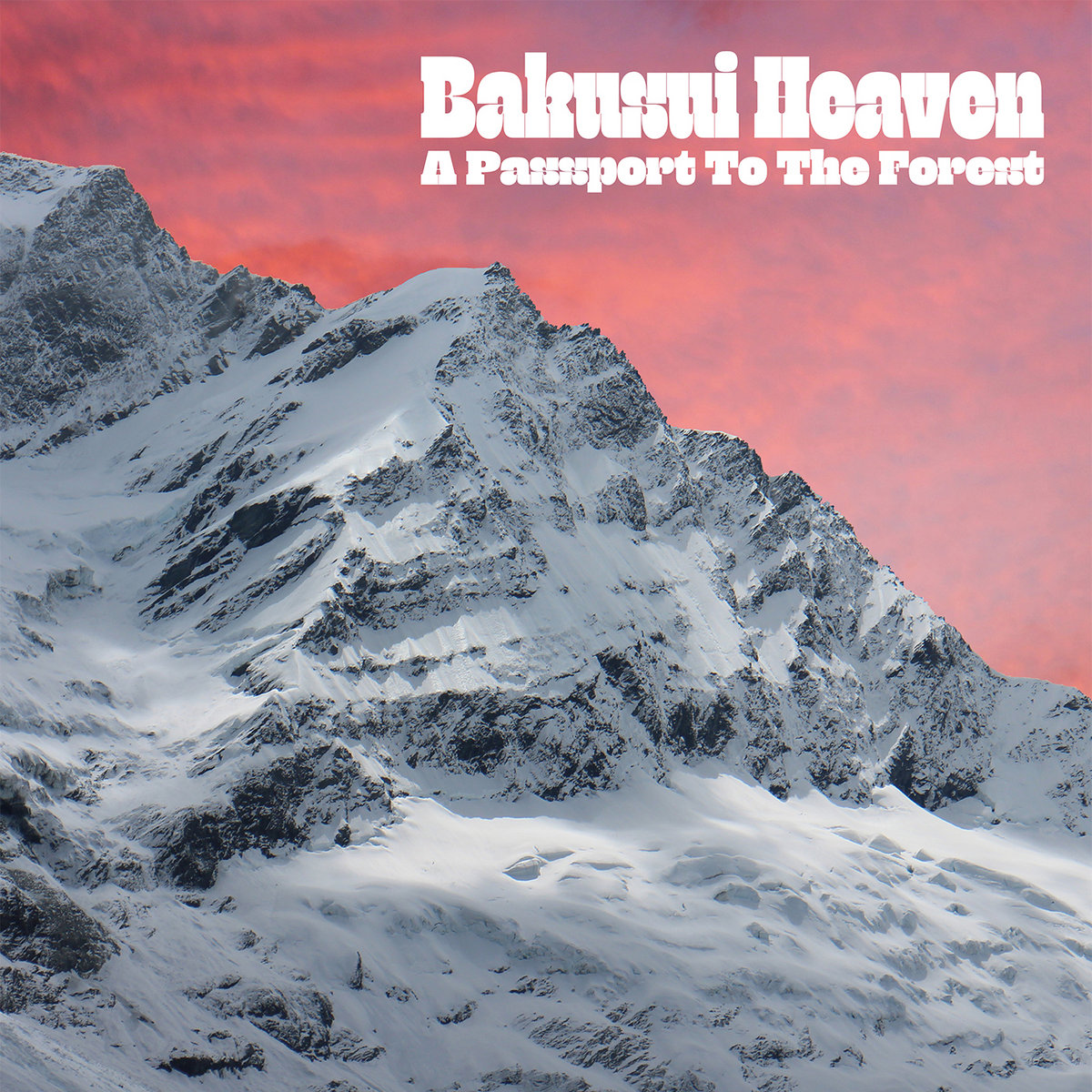
Bakusui Heaven, the solo project of Richie Troughton, recorded the album A Passport To The Forest over a two-year period at Sublime Studio in Aotearoa/New Zealand with Tom Havard and Steve Harrop at the helm. The name Bakusui Heaven comes from a Japanese term for oblivion. The music comes from psychedelic portals of sound and visual influence – spaghetti western soundtracks, literary meditations, zoned out feelings, an urgent call from time and space.
TMODM: You’ve spent years writing about and interviewing musicians from all over the world. Did that experience affect the way you approached making your own record, or did you try to leave the critic’s mind behind once you started recording?
Bakusui Heaven: Having the opportunity to meet artists and research music from places and times I am not always familiar with is a great learning experience. What factors lead to certain music as the result of social or political situations and circumstances is an education, unearthing deeper meaning and understanding of the messages encoded within the music.
Equally, the influence may be as much as getting some good book and film recommendations from a friend in the pub. Since making cut-and-paste zines in college, I was always working on music.
TMODM: You originally went into Sublime Studio intending to preserve a few rough ideas as demos, but the project gradually became a full album. At what point did the sessions stop feeling like demos and start feeling like an album?
Bakusui Heaven: There was some unfinished business for me as far as song ideas that were never going to materialise in any way. I was keen to keep a record of how these could sound, while I was still young (…!)—and initially booked a one-day session in Sublime to lay down basic tracking.
I had some very rough scraps of material to take away and digest—that demanded further attention and created a huge amount of additional work to hone the arrangements. Over the months until I could return, I went away to take drum lessons, after mercifully giving up on the idea of recording a pair of trainers doing a cycle in a washing machine for percussion.
The guidance, input and patience I received along the way from producer Steve Harrop and recording and mix engineer Tom Havard made for a nurturing creative environment, where I was looked after like family—and none of us were really satisfied until we got the results we were looking for.
I had no plans to take it any further until there was a final mix. Following discussion in the studio, we agreed that we had now arrived at a point where it was time to share the sounds. From the first session to final mastering took two and a half years.
TMODM: A lot of the album draws on things you encountered while travelling in Aotearoa/New Zealand. How much did being in that particular place change the music you thought you were going to make?
Bakusui Heaven: While the bulk of the material pre-dates the time I first visited Aotearoa/New Zealand, on arrival the landscape and environment had a dramatic, perception-altering impact on me that has no doubt played an integral part in how the results of this project came out.
When surrounded by huge mountains looking down at you, they have an energy and share that with you. They change in the different seasons and communicate. They have control and a sense of humour.
Sometimes nature made its way into the album tracks—as on “Thermo Optic Camouflage,” for example—that features early morning birdsong I recorded in Oamaru and cricket stridulation encountered in Wellington.
The song itself was as much of a studio composition due to the improvised arrangement—and these “special guest” appearances opened up new possibilities for the direction and narrative of the piece.