
Artificial intelligence has everything under control. There’s probably nothing to worry about. Well, maybe a little... or... you know, the end of humanity or something. Anyway, recent releases from Amon Acid, Skloss, Dead Sea Apes, Kanaan, Jayz and the UFOs, Gnod, Lightning Swells Forever, Cosmic Drifter, The Underground Youth, Sacred Buzz, and Dr Space.
I’m sorry, Dave...
| Time | Artist | Track Title |
|---|---|---|
| 00:52 | Amon Acid | Labyrinth |
| 04:23 | Skloss | The Pattern Speaks (David Jack Remix) |
| 07:58 | Dead Sea Apes | Psychic Tension |
| 14:40 | Kanaan | P1800 |
| 17:13 | Jayz and the UFOs | Mess Up |
| 21:26 | Gnod | The Witness |
| 31:14 | Lightning Swells Forever | The Hanged Man |
| 36:30 | Cosmic Drifter | Jackalope |
| 40:21 | The Underground Youth | Bottled Time |
| 48:23 | Sacred Buzz | Nothing To Hide |
| 54:35 | Dr Space | Dr Space Mad Elf Mess |
2025
2026
2027
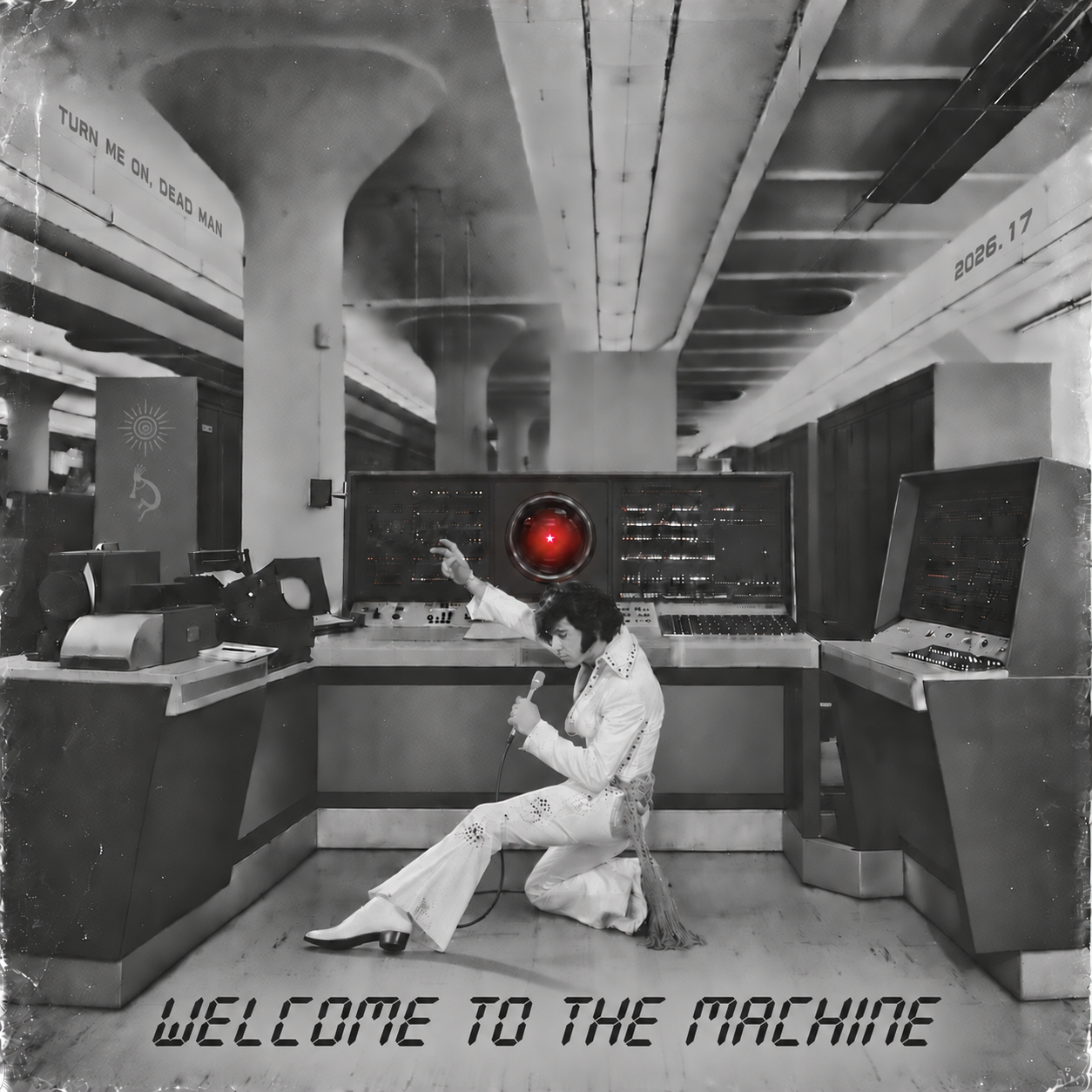
The machines have been warning us for a long time (at least in the movies). HAL calmly explains himself in 2001: A Space Odyssey. Skynet reaches the obvious conclusion in Terminator 2. The Matrix takes the idea to its logical extreme, while Doctor Who got there decades earlier. We build machines to extend our abilities, hand them increasingly complicated tasks, and then discover that we may not entirely understand what we’ve created. Maybe that’s because we don’t entirely understand ourselves. Human ingenuity and human hubris have always been closely related, and artificial intelligence just gives that old problem a new form.
Against that backdrop, the music in this episode feels reassuringly human. Amon Acid talk about the “anarchy” of jamming around a riff for the first time. Kanaan, after ten years together, can still surprise themselves with the collective sound they create. Gnod’s Paddy Shine describes getting out of his own way and letting words emerge from the subconscious. SKLOSS hand their songs to friends and collaborators to be pulled apart and “rewilded,” while Sacred Buzz recorded together in a room, maintaining eye contact and responding to one another in real time. Even Cosmic Drifter, who records largely alone, talks about songs changing once four people begin playing them together. Dead Sea Apes perhaps put the point most directly: with AI poised to change so much, Brett Savage argues that artists need to put their “hearts and souls” into what they make.
There’s an infrastructure supporting all of this as well: labels like Fuzz Club, Cardinal Fuzz, Feeding Tube, Jansen, Rocket, Echodelick, Clostridium, Sound Effect and others willing to release music that is unlikely to trouble the upper reaches of the charts, and listeners who continue looking for it. That relationship between musicians, labels and listeners seems worth holding onto. None of us knows quite where the machines are taking us, and perhaps that uncertainty is part of what makes music like this matter. These records are evidence of people listening to one another, following strange ideas, making mistakes, finding something unexpected and occasionally creating something that means a great deal to someone they’ve never met. For now, at least, that still seems like a pretty good use of being human.


Amon Acid are Sarantis Charvas, Briony Charvas, John Sutcliffe and Will Grinder. From Leeds, UK.
TMODM: You’ve said that Ikaros grew out of the same sessions as your upcoming album, but you thought these jams should be a separate record. At what point did you realize these songs belonged together as something separate?
Amon Acid: We usually record far more than will fit on a single 12". In the past we have canned entire albums worth of tracks because they didn’t fit with our particular vision at that point in time. But we also have a history of putting out some tracks that didn’t make an album before the “main” release, if they fit together or captured a different train of thought. So Left Over Acid, Diogenesis and Ikaros all fall within that category.
TMODM: The doumbek rhythm in “Labyrinth” gives it a very different feel from the heavier side of Amon Acid. Did the rhythm come first and lead the rest of the track, or did that emerge as you played around with the arrangement?
Amon Acid: The doumbek came first. Sarantis wanted to re-record a different track for the album but ended up in the studio playing around and came up with the rhythm. There were two possible songs over the same rhythm, but “Labyrinth” won.
It’s a really quite sweet dreamy tune that harks back to the softer side of Amon Acid. The contrast with “Grazer” is quite stark and the juxtaposition reflects the psychic undulations of an acid trip.
TMODM: Amon Acid started as an experimental two-piece and is now a four-piece, while Ikaros reconnects with some of the exploratory spirit of those early days. Has becoming a larger band actually made it easier to get back to experimental jams?
Amon Acid: We always jam at the beginning of practice, and rarely record what happens. These jams can last 10 minutes or half an hour depending on how we all connect to a particular idea. We have been playing together as a four-piece for a long time now and we are able to explore an idea together without having to vocalise it.
That kind of connection allows us to explore paths that eventually become ideas for songs. But there is something to be said about capturing the anarchy of jamming around a riff for the first time.

Austin / Glasgow space gaze duo.
TMODM: When we talked back in 2022, you described SKLOSS as something that grew out of jamming while being stuck together during the pandemic. Since then those experiments have grown into The Pattern Speaks and now DIALECTS. How has the way the two of you make music together changed as SKLOSS has developed from those early jams?
SKLOSS: In some ways it’s the same. A lot of our songs start with playing around together in the studio or our living room. What’s changed is that we’ve laid a foundation and language for the project now, so we usually can identify when an experiment or flight of fancy is worth pursuing.
We’re also trying some new ideas and digging deeper with the older ones…and those new songs are nearly ready to go for our next album with Fuzz Club next summer.
TMODM: David Jack has been a longtime collaborator of yours in other music and film projects. For his remix of “The Pattern Speaks” he recast it with Fender Rhodes and bass while making the contrast between your vocals stronger. What was it like hearing someone who knows your work so well completely rethink the song?
SKLOSS: David knows our music pretty well indeed and he used to be in IGLOMAT with Sandy, so he is used to being battered with a racket and chopping it up to make tunes pretty to the ear. It was nice for someone like David who is a music maestro to rethink our hit single, take it to the moon and make us sound like a legit band! lol
TMODM: DIALECTS gives every song from The Pattern Speaks to a different artist to reinterpret, and you describe the results as the album being “rewilded.” How did you choose the people who would remix each track, and did any of their versions make you hear something in your own songs that you hadn’t realized was there?
SKLOSS: DIALECTS started with Sandy asking an old friend Kerry Gatt (Dub Seva) from his BMX days to do a dub version of the track “Snorkels Ask” and we were so chuffed with it, so we figured, hell let’s just do a whole album and it snowballed from there.
Sandy ended up asking people he had old ties with, toured, or played in old bands with, looked up to, inspired by or we had both collaborated with on various projects with. Each brought their own language and dialects to the songs.
We were surprised by how tame some of the tunes became, we had no idea that was possible! A couple of the tracks made us quite emotional. It was lovely to hear the way other artists think with a musical canvas to put stems on. I guess we hadn’t realized how else the songs could be mixed up, or turned upside down and that is why we did it, to have that connection and conversation with such a bunch of magic individuals.

Dead Sea Apes from Manchester, UK. 3 person instrumental leviathan.
TMODM: You’ve described Dead Sea Apes in the past as reaching a point where you stop directing the music and just surrender to it. On Psychic Tension, though, the record is responding very consciously to the sense of overload in the world around us. How do those two things coexist, playing instinctively while the music is carrying that kind of weight?
Dead Sea Apes: I think that when you are writing music in the moment, as we do quite a lot, a lot of outside concerns don’t really invade your thinking initially. In fact, it’s kind of one of the benefits—that you can switch off and drown out some of the external pressures of the outside world. I guess that it’s when you come away from playing and piece things together, that's when other ideas creep in.
As with all instrumental music, beyond the title it can be quite hard to articulate a narrative, especially something that is as heavy and politically charged as the world is today. That’s not to say that our music is ever neutral, nor is the underlying message always some after-the-fact rationalisation—but other notions will start to feed into your thinking over time, and as a lot of our songs are things that develop from an initial idea, narratives tend to come into play as the song progresses.
TMODM: You’ve said that Dead Sea Apes usually try to capture things as vitally as possible without draining the life out of them, but this record uses more overdubs than usual. What made Psychic Tension call for that extra layer of construction, and how did you know when you’d added enough?
Dead Sea Apes: That is something that we are very conscious of. We always want to capture the responses and interplay that you can only get from us three people playing together in a room. It has a vital energy that can’t be replicated otherwise. We often record the basic track all together as a band and then start tracking any overdubs after that. And that’s not to say that we don’t like doing overdubs; this album has plenty which I feel are central to the overall sound. It’s just that we are conscious of maintaining the core vitality of the moment in the recording.
Unfortunately, as we started recording for Psychic Tension, Jack’s (bass player) partner became seriously ill and he took time off to support her. Both Chris and I carried on doing some tracking in his absence (alongside doing the Celestial Power album with Dave Cambridge)—and as far as tracking is concerned, “the devil can find work for idle hands to do”—so we did do a lot of overdubs. Thankfully, Chris (drums and producer) has an exceptionally well-honed ear for this and was incredibly judicious in cutting away the chaff that wasn’t needed. I have to say that was not a task that I would have envied though.
I feel like it’s important to keep the arts as alive as we possibly can these days. AI is really going to change the world, and I think that we really need to put our hearts and souls into everything that we do artistically. As Doug Rushkoff says at the start of his excellent podcast Team Human—“conscious intervention in the machine.” That really resonates with me. As much as I’d welcome us living in some abundant, “post-scarcity” future thanks to AI, it really does need to stay the fuck away from the arts!
TMODM: The title “Psychic Tension” came from a phrase used to describe the kinds of anxiety Valium was marketed to treat. What made those words feel right for both the track and the moment we’re living through now?
Dead Sea Apes: We live in really heightened, anxious times these days. It’s never been like this in my lifetime. All the horrors of this world are impossible to be blissfully ignorant of nowadays. Whilst you could say that it is good that important things like war, genocide, ethnic cleansing, climate breakdown, untrammelled corporate power, political corruption, things like the Epstein Files, etc., don’t pass by unnoticed any more, that doesn’t mean to say that it’s not going to take a huge toll on our collective psyche.
You would expect that with all the injustices in the world, that we as a species would no longer stand by and accept it. Unfortunately, that’s not the case. You have the rise of contrarianism and conspiracy theory culture which, whilst it poses as a challenge to power, it just serves to directly maintain the status quo. (On purpose? Is that a Conspiracy Theory about Conspiracy Theories?) The all-pervasive Culture War does its best to keep people distracted from who is really degrading our way of life.
All these things compound the mounting horror and feed into a growing sense of hopelessness that we are all feeling. It’s hard to know where we can go from here. Psychic Tension is real!

Kanaan is from Oslo, Norway. Fuzzed out Norwegian psych rock trio. Kanaan are:
Ask Vatn Strøm - electric and acoustic guitars
Eskild Mørtl Myrvoll - bass, synthesizers, Mellotron, additional guitars, no-input mixer
Ingvald Vassbø - drums, percussion
TMODM: When we first communicated in 2020, you said improvisation kept the three of you “alert and attentive.” After ten years of playing together, has that changed? Do you now know each other’s instincts so well that it becomes harder (or easier) to surprise one another?
Kanaan: The improvisational part is still an integral component of the Kanaan sound and I would still say that it helps us stay “alert and attentive.” Hehe, that hasn’t changed so much, I think.
When it comes to our playing style, both as individuals and as a group, it has probably changed a bit, but I think what’s more important is that it feels like it’s “broadening.” Or that the palette is growing in a way. I think we can still “choose to play” like we did in 2020, or in some particular style or way, but our horizons are probably a bit wider and I feel that there are even more influences, colours and sounds going into the picture.
I still get surprised by the others from time to time, for sure! But it’s more often caused by the collective sound, and when I feel that we play very good together. “Wow! We sound so good now!” I sometimes think when we practice, not wanting to sound cocky or anything, hehe. And I guess that’s a sum of all the individual parts as well... Well, it’s hard to define exactly what causes musical surprise and excitement.
TMODM: Ten years and ten albums in, you’ve made a record simply called Kanaan. What was it about this particular record that made you feel, “this is the one that should have our name on it”?
Kanaan: Lately we’ve been talking a lot about a kind of sweeping generalisation-statement that we still feel has some truth to it. The claim that “the hardest thing about being in a band is keeping the band together” is the thing we’ve been discussing. We’ve ended up concluding that we think it’s kind of true.
Since we're currently on our tenth year, and have been doing most of the musical and extra-musical operation ourselves (which can be a lot of work, and very demanding), we’re very proud of ourselves for having done it! Even without ending up becoming each other’s enemies or hating each other, hehe. The fact that we still want to play more, and that we are still extremely musically curious, is also a sign of something good, I think.
Musically, we also felt that the album ended up encompassing a lot of different sides of the Kanaan sound. It has the swirling psychedelic parts, the heavy riffs, the more improvisational stuff, the progressive thing, as well as the more soft and melodic parts. So to sum it up, we wanted to give the album the Kanaan name to celebrate our achievements as friends and colleagues, as well as the music that we love so much making together.
TMODM: “P1800” feels like a very concise version of Kanaan: direct and heavy. What were you responding to when that track came together?
Kanaan: We weren’t really “responding” to anything particular, but I think our interest in the more punchy, blues-oriented rock side of things maybe came a little bit together at the same time.
When we wrote the song we were located in a very lovely theatre in Stamsund, Lofoten, in the north of Norway. We stayed there a couple of days to write new music, hang out and look at the northern lights. I remember that the song actually started with the drum groove. I had recorded some beatboxing on my phone, and when we met I showed Ask and Eskild the groove. From there on they started throwing riffs at each other, and after a while it ended up as “P1800.”
I also remember that we did a lot of changes in the studio, so the final arrangement got finished during recording. The thing about the length is just that we like having a bit of silly fun with stuff like that. The B-side of Kanaan will have “The Wonderer” on it, which will be our longest composed song until now. With “P1800” being our shortest, we kind of think they fill out each other in a way, haha.
Lille-based quartet Jayz and the UFOs shatters genre barriers with a boundary-free indie rock. Blending raw garage, heavy stoner, cosmic psych, and catchy pop, they land between Wand and All Them Witches. No elitism, just pure sound at max volume.
TMODM: Several songs on Gallows Stew (“Mess Up,” “Lost Babylon,” and “Do You Know My Name?”) appear on Mixtape 1 (although I can't seem to find this anywhere). What changed between those first versions and Gallows Stew?
Jayz and the UFOs: Mixtape 1 was recorded several years ago. The sound quality wasn't great and some parts evolved over time, especially with the line-up changes. All of this pushed us to re-record the songs between 2025 and 2026. Upgrading our gear and refining our skills allowed us to deliver a result we're truly proud of.
Gallows Stew is our very first album, with two bonus tracks available only on the physical release.
TMODM: You describe the band as moving between garage rock, stoner rock, cosmic psych and pop without much concern for genre boundaries. When you’re writing a song like “Mess Up,” do you consciously pull from those different influences, or do things happen more naturally once the four of you start playing together?
Jayz and the UFOs: We all come from different musical backgrounds, but as soon as we start playing together, everything aligns. We love playing together, and I hope people can feel that energy in our songs. When we compose songs, we don't care about boundaries.
TMODM: The name Jayz and the UFOs sounds like it belongs to a band with a backstory. Where did the name come from, and has the Jay-Z confusion been a blessing or a curse?
Jayz and the UFOs: Jayz fights for justice across the universe. In this endless mission, the UFOs have helped him countless times, making the universe a little better along the way. Our name is a tribute to their work.
We like to think that Jay-Z paid his tribute to the real Jayz when picking his name. We have no proof of that, but clues don't lie. We see this connection between Jayz and us as a blessing, mostly because we are all great musicians playing the things we like.

Gnod are a British rock band from Salford, Greater Manchester, England. Formed in 2006, the band was described in a review of its 2011 release Ingnodwetrust as "a collective from Manchester with an ever-rotating list of members." Its current lineup since 2012 is made up of key members Paddy Shine, Chris Haslam, Marlene Ribeiro, Alex Macarte and Andy Blundell, with a rotating cast of players, including drummers Jesse Webb and John Perry and vocalist Neil Francis.
TMODM: The songs on Vol. 2 were apparently developing on the road for a couple of years before you recorded them. At what point does something that begins as spontaneous playing become a Gnod song? Or is that not really how you think about it?
Gnod: Good question. It's an organic process and it's always open to changing. It's on the road where the length and structure of a piece really solidifies.
TMODM: You told me that the decision to make three albums only came after listening back to the entire Hellfire session. Vol. 2 feels considerably heavier than Vol. 1. How did you decide what each volume should emphasize, and how the material should be divided between them?
Gnod: Again, it was all fairly organic. The volumes kind of put themselves together based on the sound and direction of each piece of music. It was fairly obvious to us how to sequence the tracks on the albums and the volumes themselves.
TMODM: When you’re playing something like “The Witness,” how much are you thinking about the words and what they mean, and how much are you just responding to the sound and feel of the band in the moment?
Gnod: Mostly responding to the rhythm and groove and getting out of my own way to let the subconscious mind start spitting words out. I guess that's a pretentious way of saying I make it up as I go along, haha.
Lightning Swells Forever is Japanese heavy psych band formed in 2016.
Experience the sound from thundercloud of fuzz.
ZOE/
ELECTRIC GUITAR,VOCAL
KEITA KAWABATA/
BASS
TAKUMA MAEDA/
DRUMS
70sロック直系のリフとサイケデリックな音像でヘヴィロックを轟かせるパワートリオ。バンドの根幹をなすギターリフは、ダークで壮厳でありながらも疾走感を感じさせ、獰猛なリズムと共に唯一無二のオリエンタルな世界を作り上げている。
TMODM: Delirium originally came out independently in 2025, and now Clostridium Records has given it a vinyl release, with Echodelick also carrying the album. How did you first connect with Clostridium, and what made them feel like the right label to bring the album to a wider audience?
Lightning Swells Forever: After we released Delirium digitally and on CD, Andy from Clostridium Records contacted us through social media.
What really motivated us to work with Clostridium was that we could feel Andy’s deep understanding of and enthusiasm for our music. At the same time, we could also sense his genuine passion for creating and releasing music in the vinyl format.
We felt that, in order to bring our kind of music—proto-metal made in a country in the Far East, thousands of miles away—to a wider audience, what mattered most was someone with a genuine understanding of the genre, along with a real love for the old-school LP format.
TMODM: “The Hanged Man” opens Delirium and immediately establishes a dark, ritualistic atmosphere. What was behind the title, and was the image of the Hanged Man—whether from tarot or somewhere else—part of the song from the beginning?
Lightning Swells Forever: When I came up with the riff for this song, the heaviness of the sound somehow made me imagine a huge, decaying tree deep in an ancient forest. From there, the idea of a man hanging from a tree came to me.
As you probably guessed, that led me to the image of The Hanged Man from the Tarot, which became a major inspiration for the song.
The Hanged Man certainly carries the image of execution, but the card also represents seeing the world upside down and gaining a new perspective. I think that duality between death and life became an important part of the idea behind the song.
I think the tempo change in the middle of the song expresses that image particularly well.
TMODM: Lightning Swells Forever has been around since 2016, but Delirium is your first full-length album, and it even revisits “Daze,” a song that goes back to your first EP in 2017. What changed in the band between those early recordings and Delirium, and what finally made this feel like the right time to make a full album?
Lightning Swells Forever: Originally, we played music that had a much more authentic hard rock and garage rock feel. From there, we gradually became more interested in heavier and more doom-oriented music, and over the years we've absorbed dark music from many different generations.
It wasn't just heavy music, either. Even Delta blues can have a kind of doom vibe to it, don't you think? We've spent a long time absorbing those kinds of sounds and feelings, and eventually we felt that we had developed that vibe within ourselves as well. That's when we decided it was finally time to make a full-length album.
We never wanted to be the kind of band that simply turns everything up loud, steps on a fuzz pedal, and goes, “DOOM!!!” 😂
One man desert / space rock band from Barrie, Ontario.
TMODM: When we corresponded in 2022, you said you were trying to get beyond your old songwriting habits by layering sounds and creating more atmosphere and tension. Listening to On the Shores of the Cosmic Ocean, it seems like you've gone much further in that direction. How has your approach to writing and recording changed over the last few years?
Cosmic Drifter: While I was working on Shores, I really tried to hone a few different guitar tones that would mesh and complement each other. I feel like I've finally found my “sound” or niche in that regard. I record all the instruments and vocals at home by myself in a makeshift studio, so there are challenges that come with that too.
I've learned a lot about EQ and mixing over the last few years, which I think gives this album a brighter, clearer and more articulate sound. The drums and bass sound better and sit a little higher in the mix, and I've added some synth too, which was a new direction for me.
I allowed the guitar leads to get a little more adventurous on this record, which wasn't really a conscious decision so much as simply having fun jamming along to the tracks.
TMODM: You handled so much of On the Shores of the Cosmic Ocean yourself—writing, recording, production, even the artwork—but Cosmic Drifter also appears as a full band in photos and live videos. How does that relationship work? How much does the rest of the band contribute to the writing and recording in the studio?
Cosmic Drifter: So far it's been me writing and recording everything, and then as a band we try to recreate it live, but most of the songs naturally evolved over years of the four of us rehearsing them. Everyone contributes their own unique approach to playing music, so the live set has kind of become its own thing.
I appreciate the guys in my band so much for being on board with my vision, for the time and effort they put in and for putting up with my perfectionism. It's tough out here for working-class musicians approaching middle age, lol. We all have responsibilities.
I'm working on a new batch of songs already and the next record may have some writing credits from other band members, as a couple of the new ones have emerged somewhat collaboratively, so keep an eye out for that.
TMODM: The album title also evokes Carl Sagan’s idea of standing on the “shores of the cosmic ocean.” Was that the concept all along, or did that emerge as you were making the record?
Cosmic Drifter: I've been a fan of Carl Sagan ever since I watched his Cosmos series from the eighties. It's full of fascinating stuff and the retro vibe is so cool. The soundtrack was done by Vangelis, who also did the Blade Runner soundtrack, and it just creates this incredible atmosphere. Carl's presence and the music and the eighties production value gives the whole series a very comforting, nostalgic quality as well.
Sagan's approach to science, to the cosmos and to life in general really goes hand in hand with the psychedelic experience, for me anyway. I had been working on the title track, an instrumental featuring one of Carl's speeches, for a couple years. I wanted to address the cognitive dissonance between feeling awe and wonder towards the cosmos versus the abject cruelty and corruption of human society and our inability to see the bigger picture.
The fascinating structures and processes of life and the physical world are going on around us at all times just waiting to blow our minds. I doubt we'll ever get our shit together as a species, but contemplation of the infinite is always there as a refuge for the individual, which is something I tried to express throughout this record. Hail Sagan!
The Underground Youth was started in 2008 as the creative project of Craig Dyer. The band have released 10 albums and 4 EPs, over the years developing their unique sound, which has ranged from cinematic lo-fi psychedelia to a raw and noisy, albeit romantically melancholic, form of post-punk. Shrouded in a dark aesthetic and the imagery of various art film movements, The Underground Youth have established a devoted global following and cult fan base, continuously built upon by their extensive touring schedule through Europe, Asia and North America. Signed to independent record label Fuzz Club Records in 2012, The Underground Youth currently consists of Craig (Vocals/Guitar), Olya Dyer (Drums), Leonard Kaage (Guitar/Producer) and Samira Zahidi (Bass). The band relocated from Manchester to Berlin in 2016.
TMODM: “Bottled Time” began as part of the soundtrack to Die Schöne Blüte, but you've said it stayed with you long after you recorded it. What was it about this particular piece that made you want to release it as a standalone single?
The Underground Youth: Once I'd finished recording “Bottled Time,” I kept listening back to it on repeat. Now, this doesn't always happen when you've finished working on a song. Sometimes you put so much into the writing and recording that you need a break from the track once it's done. But sometimes (like this time) I had the finished track on repeat. That pushed me into the decision to release the song as a standalone single.
TMODM: Writing for a film is different—it gives you scenes to respond to. Did composing for Die Schöne Blüte change the way you approached “Bottled Time”?
The Underground Youth: Writing and recording the music for a soundtrack is certainly different to the approach you take to recording an album. I don't approach the two things in the same way. With the soundtrack, you absorb the film and respond to what you envision as the background to the visual.
“Bottled Time” is very prominent in Die Schöne Blüte, as it features as a song in its entirety over a montage sequence. So it wasn't written in the way I'd usually approach writing a song for The Underground Youth, and it also wasn't created in the way I write the more background elements to the soundtrack. It's something of a mixture of both.
TMODM: “Bottled Time” feels restrained and atmospheric compared with other Underground Youth releases. Do you see this soundtrack work as opening another direction for The Underground Youth, or as its own distinct part of your creative work?
The Underground Youth: I think the soundtrack work stands alongside The Underground Youth's catalogue, but it's not a direction the next albums will take, for example. It all exists as standalone work, and what inspires what comes next, as always, could come from anywhere.
I'm currently working on the next The Underground Youth material, and not even I can say yet where that's going.
Sacred Buzz is a Berlin psych band known for their electrifying live presence and deeply immersive soundscapes. Their sonic palette bridges vintage and modern: garage‑rock grit, krautrock repetition, psychedelic drones, and proto‑punk drive.
On stage, Sacred Buzz delivers a psychedelic potion: hypnotic drums, throbbing bass, fuzzy guitar reverberating like a lost transmission, droning organ, lo‑fi vocals and surreal lyrics that drive your soul up to the 13th floor and then back to velvet underground in a hazy dream-like vision.
On 1st November 2024, their debut EP Radio Radiation was released on Irish Fuzzed Up & Astromoon records on cassettes and digitally and received critical acclaim with various radios, blogs, and outlets throughout Europe, the UK, and the US.
TMODM: In the past you emphasized the influence of '60s psych garage. Did your way of writing change as you moved toward this more krautrock-oriented sound of your new album?
Sacred Buzz: Not really. I would say it's a steady evolution rather than a drastic change of approach. In my writing I usually try to capture the feeling or mood and then see what would be the perfect vessel to convey it, be it certain effects, drum pattern, or interplay between different instruments.
I usually try to combine ideas from different fields in my songwriting. "Nothing to Hide" is the example of that, blending monotonous drony flow with mantra-like statements about the freedom inspired by philosophy books I read at that time.
TMODM: You've described "Nothing to Hide" as being about freeing yourself from old beliefs and being honest with yourself. Did that idea come first and shape the music, or did the hypnotic groove suggest that theme after the track had started to take form?
Sacred Buzz: I guess I had that mood and came up with that idea of having a mantra-like song. One evening I found the basic guitar groove for the song and just started singing vocal melody. I knew it should be something repeating. The line "nothing to hide" felt perfect rhythmically, so I rolled with it.
Soon we played the song with the full band in our studio and a few more pieces fell into place. Drums and bass found their pocket right away and Jane, our keyboardist, came up with this beautiful riff on the organ that felt nostalgic and yet like some revelation.
The song was missing the final piece and so I came up with the lyrics around the initial line, added a chorus and it was ready to be put on tape.
TMODM: You recorded the album in just three days at Monoton Studio. Did working that quickly help preserve the live energy of the band, or did the studio bring out a different side of Sacred Buzz than people might hear at your shows?
Sacred Buzz: Yes, the main idea was to preserve the live energy and I think it worked out. It was very exhausting, though, as we had to work very fast. Our recording engineer Fabien de Menou (from Perilymph band) is truly one of a kind and it felt like he understood our ideas almost telepathically.
We recorded all the main instruments at the same time and music feels alive because we were keeping eye contact and emphasised each other's strong moments. There was definitely some experimentation involved. For instance, we had a couple of guest musicians that helped us enrich the sound palette in a few songs. And there was even room for trying new parts in different songs. Some of these we've since incorporated into our live set.
Dr Space, aka Scott Heller, plays in Øresund Space Collective, Black Moon Circle, Doctors of Space and contributes synthesizers to many other bands and projects. This site is for his solo works. Enjoy..
TMODM: “Dr Space Mad Elf Mess” came from two days of jamming in Portugal with members of Madmess and It Was the Elf, along with Jonathan Segel. What do you listen for in musicians you haven't improvised with before, and how quickly can you tell when a group has found the right chemistry?
Scott Heller: The key to improvisation is being a good listener and being able to find your place in the music. Experience helps as well, but the most skilled musicians are not always good at just jamming, so I look for good listeners and guitar players that like to do solos!! As for recognising the right chemistry, you figure it out pretty fast, if people seem lost or unable to find inspiration.
TMODM: “Monts,” “Zephyr in Orbit,” and “Dr Space Mad Elf Mess” come from three different groups of musicians, but your electronics and synthesizers provide a thread running through all of them. Do you approach each collaboration in a similar way or does each one require a different approach?
Scott Heller: I have a lot of synthesizers that I can use in my studio and played different ones in the studio in Stockholm, which was fun. For UMMA, it was clear it had to be spaced-out sounds, so I used certain ones like the Monotron and modular synth the most.
For the Mad Elf Mess sessions, Jonathan was using a bass synth and the Fender Rhodes piano, so I did not play many of the keyboard synths, mostly others. So they are all a bit different.