
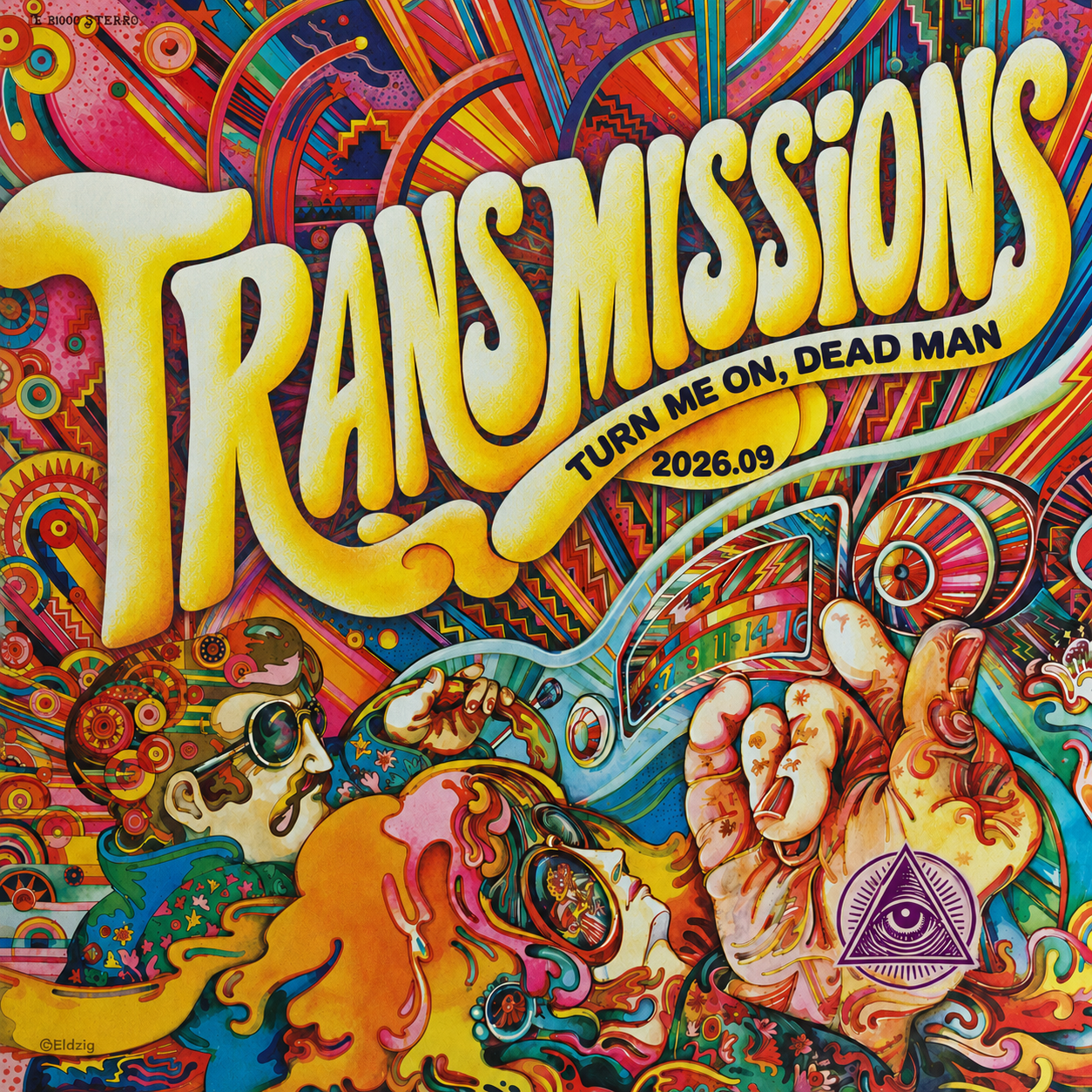
Transmissions from above. Recent releases from Some Pills For Ayala, Haare, Ghost Patterns, Celestial Power, Jeffrey Alexander & The Heavy Lidders, The John Denver Airport Conspiracy, The Noir Dalis, The Heavenly Bodes, Kalamata, and Herb Lore.
| Time | Artist | Track Title |
|---|---|---|
| 00:32 | Some Pills For Ayala | Flying to Nowhere |
| 04:43 | Haare | Empty Black Mirror |
| 10:11 | Ghost Patterns | Silhouette |
| 14:38 | Celestial Power | Politics Of Ecstacy |
| 24:23 | Jeffrey Alexander & The Heavy Lidders | From Loch Raven To Fells Point |
| 31:18 | The John Denver Airport Conspiracy | The Wheel |
| 34:34 | The Noir Dalis | Drift |
| 37:57 | The Heavenly Bodes | Acting |
| 40:48 | Kalamata | Coming |
| 48:47 | Herb Lore | Enlightenment |
2025
2026

Chilean Psychedelic Doom/Stoner Metal band from Santiago.
TMODM: This episode of Turn Me On, Dead Man opens with “Flying to Nowhere” from Dystopia, even though you’ve already moved on to a new album with Incarnate. Does that track still feel connected to where your music is now, or does it belong to a different moment for you?
Some Pills For Ayala: When I’m writing material, the truth is that it’s a natural process where I play riffs and look for passages that make sense or catch my attention. It’s a natural process. I have to admit that the approach differs from one album to the next, but essentially, for me, it’s a process of discovery to see how far I can take a song or disparate sounds. I never know where I’m going, and I think I seal a song’s fate when I add the vocal melodies.
TMODM: When we last talked, you described the songs as coming together quickly from whatever idea appears first — drums, guitar, bass — and you also mentioned using dreams in your lyrics. With Dystopia and now Incarnate, has your process changed at all, or are you still trying to follow the first impulse before it disappears?
Some Pills For Ayala: It's basically the same thing. My songs usually start with the guitar. When I have an idea, I record it with a metronome so the beats are in time, then I start working on the drums and use them to structure each song. Once I have the basic structure, I record it over and over until I’m happy with the song’s concept. Then I work on the sound with my pedals, trying to record as authentically and analog as possible. I don’t usually record clean guitar tracks to process them later on the computer—the take is almost live.
When I finish that process, I record the bass, and I always record the vocals last. Since I’m alone in my studio, I rehearse and record at the same time, though I essentially prioritize the fresh idea that came to me at the beginning, and I only arrange the song and emphasize certain elements to structure it as such. It’s always in service of the song. In this process, I generally leave mistakes in, since I want it to be as human as possible.
TMODM: You’ve said before that making music helps you stay mentally healthy. With Dystopia and Incarnate, do you think of these records as a way of getting something dark out, or more as a way of pushing through it?
Some Pills For Ayala: Yes, for me, in my journey as a musician, even at 55, it’s still a state of liberation. When I was younger in my hometown (Santiago, Chile), I played in many local bands. Playing live used to stress me out too much, but the creative process in the studio and the rehearsal room was always what I enjoyed most. This project was born during the pandemic, and since then I’ve felt very comfortable shutting myself away to create music—first and foremost—for myself. I enjoy the creative process and continue to use it as my personal therapy.
When I write songs, I have to make it clear that I don’t know where they’re going—it remains a discovery as I create, and the process itself is what triggers the greatest release of dopamine (I think that’s the chemical term for it in my brain). Therefore, saying that music is my drug is very accurate. To be clear about the question, what I do remains intuitive and unplanned—it just flows.
Power industrial noise project from Finland.
TMODM: When I've played tracks by Nolla and Kaliyuga Express on Turn Me On, Dead Man, you've mentioned that the band's atmospheric spacerock comes from playing together and acting as 'transmitters, vessels for the music'. Since Haare is your own distinct creative vehicle, how does your approach to writing and recording an album like Paradise Never differ from that collaborative approach?
Haare: First, it is a genre thing. Spacerock and such are more or less established, genrefied, and often expected to contain certain attributes, whereas what I do with Haare, has a lot less rules. Also in Kaliyuga Express, other people have more say in the final product, but Haare is not a democracy. The basis of "Paradise Never" was the idea that JM does the bass riffs, the drummer plays along and I do what I want. I gave myself total freedom on the guitar parts.
TMODM: You describe Paradise Never as the fulfillment of a long-time dream to make a psychedelic noise rock album as a power trio. What did that trio format allow you to do that wouldn’t have worked in other formats?
Haare: Even though I play most instruments adequately (for my own needs!), I totally SUCK at playing drums, heh. The bass and drums providing the backbone for me to play around was the main thing, and another huge difference was that we were recording in real time, in the same room. Usually, Haare albums are recorded bit by bit, sound by sound, and I assemble them in my private studio, alone. This time we had two recording sessions at the Redgate rehearsal room. The first session became "Paradise Never", the second session will be out on vinyl through Heavy Meditations later this year, titled "The Great Dying". It will also contain one long track me and JM recorded separately (more in the old Haare style, gongs and guitar drone, no drums on that one.)
TMODM: How does the opening track “Empty Black Mirror” set the tone for the album, and what does that image of an empty black mirror mean to you?
Haare: I think you pretty much know what's coming...it sets the mood. JM's mother found the whole album very meditative, and that's something that seems to often happen naturally with Haare albums. I guess the playing actually conveys the feeling that was present in the studio. These sessions were very relaxed, and everything came out naturally, flowing like a stream, and again it felt like I was simply a vessel, channeling what came out of my amp. The concept of the "Empty black mirror" is a reference to the Buddhist term "Sunyata", usually translated as "emptiness". I think this quote from American Buddhist monk Thanissaro Bhikku sums it up pretty well:
"Emptiness as a mental state, in the early canons, means a mode of perception in which one neither adds anything to nor takes anything away from what is present, noting simply, 'There is this.'"
That is the basis of meditation, and to me, playing music is a form of meditation. I also like to think of it as a reference to some kind of "ego death", when looking into the mirror, you don't see a reflection of "you" as a person, but the black emptiness you are simply a part of. The blackness contains everything, and we are all of that black emptiness.
Ghost Patterns are a psychedelic shoegaze band from London. Since forming in 2019, they have shared stages with the likes of Helicon, Cult Of Dom Keller, Daiistar, Magic Shoppe, New Candys and most recently supported Ceremony East Coast, Tremours and The Dharma Chain on UK dates which has seen them garner further support across the modern psych and shoegaze communities.
Inspired by 60's psychedelia, the late 70’s/ 80’s independent scene and the early UK shoegazing era, their songwriting captures a range of energies; at times delivering a certain directness and intensity and at other times invoke wider, more expansive lush cinematic type arrangements. Their live performances often go beyond the confines and discipline of the recording environment, leading to freer improvisations reminiscent of the modern psych scene. Expect washed-out guitars and effects including a cacophony of delays, reverbs, fuzz and feedback, complimented by an array of analogue synth sounds.
Their current live show has a five piece line-up, featuring songwriter Terry Hale (vocals/guitar), Christian Ruffy (guitar/vocals), Barry Ang (keyboards), Andrew Paxton-Gray (bass) and James Walker (drums).
TMODM: How do you decide what a Ghost Patterns track needs when you're building it up in the studio, versus what it needs when the full five-piece takes it live?
Ghost Patterns: The process of writing is somewhat different to live, as various constraints are as such which limits our writing time together. This new batch of tunes for the album were written and recorded incrementally at my home studio in isolation over a period of time, alongside other tracks from the new album.
It seemed to work doing it this way and allowed for several overdubs to build up naturally as an internal dialogue in response to previous takes and ideas. After a process of listening back to the recordings, some of the original ideas that hit the moment that couldn’t be re-created stayed in, whilst other more ‘functional’ parts got re-recorded for the mixing process.
When it gets to the full band situation, it takes on a different dynamic for sure. This change is inevitable based on having five players being in a room together and responding to each in real time. So yes, I think there’s room for both approaches to co-exist on some songs and people coming to the live shows should definitely hear this.
TMODM: "Silhouette" gives us a preview of your second album, Mirror Image, coming out this November. You've mentioned the new record tackles some heavy themes like information overload and deception. Since you draw so heavily from 60s psych and early UK shoegaze, how did those classic influences help you address these very modern anxieties?
Ghost Patterns: I think society's anxieties will always exist depending on the era and context of the time, it’s just it seems to me that the music I started to follow as a young person has carried through the generations and I guess been applied to the current day. It’s not hugely intentional, but for me the process always tends to start with the musical idea with its base in psychedelia and the shoegazing era, then based upon that backdrop song themes emerge. A soundtrack if you like to which thoughts, feelings, and ideas can emerge, albeit often quite slowly and abstractly!
The final lyrical process for the album, for example, was a good four weeks going back and forth between various songs to build up a coherent structure, although odd lines and phrases would have been building up on my phone notes way earlier in a lot of cases.
TMODM: Your music blends heavy fuzz drones, layered guitars, and a dreamy shoegaze atmosphere. When building a track like "Silhouette," do you start from a sonic idea or a songwriting idea first—and how do you know when that dense soundscape is "complete"?
Ghost Patterns: "Silhouette" was definitely one of the last songs to emerge for this new album, that’s for sure. It started with a repetitive single chord riff, then another layer for a bass part, split as a high and low octave variation. In a sense the song was not constructed in advance, so it acts essentially as a lone jam to myself which extensions were added and then lyrics applied to it at the end.
Any gaps which revealed themselves during the listening back stage came pretty quickly to add live in the recording moment. Knowing when it’s finished varies from song to song I guess. I think you just get a feel for what seems to work or doesn’t, but for "Silhouette" it was done pretty quickly without too much agonising over, which can definitely happen on some tracks!

Recorded during downtime but sounding anything but casual, Celestial Power emerged when Dead Sea Apes’ Brett Savage and Chris Hardman linked synaptic overload with Cardinal Fuzz’s own Dave Cambridge to form a three-headed amplifier cult.
Heavy, raw, and deeply resonant, this is music that embraces volume, repetition, and the beauty of imperfection. What they’ve summoned is a sprawling liturgy of overdriven guitar mantras: brutal, blown-out, and gloriously repetitive. Imagine the Velvet Underground locked in a warehouse mainlining the kosmische pulse of some forgotten Krautrock commune while Bardo Pond’s ash-coated spirit hovers overhead, scattering embers into a storm of PSF-style amplifier abuse. Not so much songs as tectonic events. Not riffs, but rituals. This thing doesn’t purr it howls.
You hear the room breathing. You hear amplifiers gasping as they’re pushed past mercy, past design, into some ecstatic mechanical breakdown. Every repetition drills deeper, pushing beyond the horizon line until time itself starts peeling back in sheets. And that’s the point. This is repetition as revelation. Volume as transcendence. Human hands wrestling raw electricity into shape, then losing control of it entirely.
On “Mandate Of Heaven,” the circle widens with the arrival of Nik Rayne (The Myrrors), adding another dimension to the ritual, a desert prophet stepping into the feedback storm, pushing the album’s gravitational pull even further into the void. No compromise. No softening. No edges filed off. Just pure voltage, scorched earth repetition, and the kind of heavy psychedelic communion that feels less like listening and more like surviving.
Step inside.
Bring ear protection.
Or don’t.
TMODM: Celestial Power brings together members of Dead Sea Apes and Cardinal Fuzz into a “three-headed amplifier cult.” How did this dynamic differ from your past projects, and what new creative space did it open up for you?
Brett: Most of the Celestial Power album comes from some downtime that we had with Dead Sea Apes. Jack (Toker - our bass player)'s partner was seriously ill and our regular practice had to be put on hold for a while. Very pleased to relate that Liz is doing great now - but was a very time for them both. Chris (Hardman - Drums) & I kept the home fires burning by meeting up regularly to record or do some stripped down jams. As he's a good friend of us all, we asked Dave to join us for a jam, not really expecting anything other than a fun session. We were all really pleased with the result. Both Dave and I have had some jams together at our houses before, but this was completely different. It was also a different vibe from DSA (even if a lot of the same influences were pouring in). It certainly felt a lot wilder and unstructured than what we do as a band. Dave was adding his playing to the mix, which sent us off into different territory.
This was recorded a few years ago now - and life really has really gotten quite crazy in between but now felt like the right time.
TMODM: The track “Politics of Ecstasy” opens the album. What does that title mean to you, and how does it set the trajectory for what follows?
Brett: In all honesty, titles often come after the fact. Dave had found that groovy Timothy Leary sample, so that made me think of his book 'Politics of Ecstasy' (which I have upstairs in my attic). I think that this was the first jam that we had - but it really set the tone.
TMODM: Could you talk a bit about the physical setup for this recording? Were there specific pieces of gear or mic placements that helped capture that incredible feeling where you could "hear the room breathing"?
Brett: Well, our practice space is always rigged up for recording. The amps and kit are already mic'ed up and there are overheads in place. Chris is a sound engineer by trade, and records every DSA practice - so we got there ready to go! These tracks are all live (save for Mandate Of Heaven, which is mostly live - with minimal tracking) so there was no tracking after the fact. Youre hearing what was going on in the room in the moment!
TMODM: When you are tracking something that locked-in and minimal, how do you manage the tension in the room? Do you have to enter a collective headspace to push the music past mere repetition into something truly immersive?
Brett: Thats where the spookiness comes into play. Obviously, Chris and I have played regularly for years - and you do learn to lock in with each other. Chris is uncannily good at picking up on threads and amplifying the dynamics. Dave tuned in straight away and it felt completely natural. You then just have to surrender to it.
Dave: For myself, I felt lucky to be able to sit with my best friends and just spend three hours losing my mind in the best possible way. When we started no destinations were discussed - Just that I was in open C tuning on the 12 string, then we started and stopped only when cramp set into my fingers.
Everything came really easily and to me it felt like catching a wave and then trying to hang on for as long as humanly possible. (I’ve never surfed, but the metaphor seems right.)
It meant I could just relax into the sonic nirvana and fully immerse myself in the sound and vibrations. It felt fucking good, no worries about hitting wrong notes. (Do they even exist?) - you can only embrace imperfections by fully letting go and from a listening experience, I’ve always felt that once you push through five minutes, that’s when your consciousness starts freeing up and time starts to dissolve, that's what we had in that room on that day. 8)
TMODM: The album features a guest appearance by Nik Rayne of The Myrrors. How did that collaboration come about, and what did he bring to the session?
Brett: Nik was staying with me for an extended stay, so we made sure that he sang for his supper! This was a few years ago now. We had dragooned him into playing on the DSA album, The Free Territory.
Nik is such a brilliant guitarist and overall musician, that we were never in any doubt that he would be anything other than terrific. We felt that this track fitted in perfectly with the rest of the album.
Founded The Iditarod in 1996, Black Forest/Black Sea in 2003 + Dire Wolves in 2008. Joined JOMF in 2013. Started The Heavy Lidders in 2019. Pome Pome Tones label + radio show. Former label owner of Magic Eye Singles + Secret Eye Records. Also on records from Kemialliset Ystävät, Avarus, Es, Fursaxa, Christina Carter, Gravenhurst, Jeffrey Alexander-Andrea Belfi-Stefano Pilia Trio.
TMODM: I’m based in Maryland, so the title “From Loch Raven To Fells Point” immediately caught my attention. What drew you to those Baltimore reference points specifically? Were you trying to capture something about the city itself, or do those places carry a more personal or symbolic meaning for you?
Jeffrey Alexander: I'm also from Maryland, born and raised - although I moved away in the late 90s. Last summer, my family and I had a terrifying near death experience and it effected me a great deal. I spent a lot of time processing that incident and one of the things I kept going back to was remembering friends of mine who have died. One of my best friends from Loch Raven Senior High school - Donnon - passed away 25 years back. We used to go to Dead shows together and had many great adventures ... so I had been thinking about him a lot and the songs on my new album slowly started to take shape in a sort of tribute to him. For me, anyway. Loch Raven reservoir was where I first met him and the last time I saw him was when I was working at a record store in Fells Point. The front cover of the album is photo I took of Donnon in 1989, when he was in liquid form. The pic on the back is the whole Dulaney Inn "Dead Night" crew also from '89 - Donnon is seated in the middle.
TMODM: A lot of psychedelic music gets associated with the West Coast or desert landscapes, but your music often feels deeply rooted in the Mid-Atlantic and Northeast. Do you think Philadelphia, Baltimore, and that whole corridor shape the feel of your music in ways people might overlook?
Jeffrey Alexander: I'm not sure about that. Its possible, I guess, but I didn't actually start making my own music until I left Baltimore. Up until that point, I was a massive consumer of music - collecting records, working in a bunch of different Baltimore record stores, DJing on WRNR-FM, and putting on DIY shows and so forth. Well, I did play in an indie rock band in Baltimore in the 90s but my music didn't start getting wildly improvisational and psychedelic until I moved to Providence, Rhode Island in 1999. And then maybe even more so when I moved to San Francisco in 2011. I've only been back here on the East Coast (in Philly) for a few years. For sure growing up with an arty-punky Deadhead 80s Baltimore scene has informed my brain for all time, but its all mixed up I guess. Certainly some Northeast and West Coast vibes creeped in too.
TMODM: How much of the Heavy Lidders material is composed versus being improvised while the tape is rolling?
Jeffrey Alexander: It depends on the album. The first Lidders record was entirely composed and very song-oriented - my chord changes and flow charts were passed out to the others. A huge change from the spontaneous approach of my DWLVS/Dire Wolves band. The second Lidders LP was all free-improv jams from the same session. And subsequent records have been a little of both - getting a little more DWLVS-y every day. On this most recent one, we improvised in the studio totally and then I edited the material and wrote lyrics later, overdubbing vocals - manifesting songs out of space. Or into space.
The John Denver Airport Conspiracy are from Toronto, Ontario. An LSD infused jangle of melody and 12 string that melds Love, The Byrds, The Velvet Underground ,Pretty Things, Television Personalities, BJM, Stereolab into one glorious orgy of sound. The John Denver Airport Conspiracy will take you by the hand and lead into a psychedelic dreamworld of electric sugarcube flashbacks, Dig In.
Cameron Brown - Guitar, Mellotron, Percussion, Vocals
Joe Frost - Guitar
Kyle Topolnisky - Bass, Vocals
Nate Fisler - Drums
TMODM: Songs of Mass Destruction! is a full band record with a producer, pedal steel, and multiple sessions at the Sugar Shack. How did the lineup solidify, and did writing for a full band change the way you approach the songs?
The John Denver Airport Conspiracy: Me and the guys in the group go back over a decade ago to when we were all involved in Oshawa’s music scene in separate bands. Us all living in Toronto now.
Writing songs for us is usually a process where one of us brings in an idea, whether it be a verse-chorus, or even just a riff that has been stuck in our heads and then seeing where the song takes us musically. With the lyrics typically being written by Kyle and I.
TMODM: Songs of Mass Destruction! Are these songs a response to a specific political or cultural moment, or is the title more of a wry frame around material that was already there?
The John Denver Airport Conspiracy: I wouldn’t necessarily say there is a lyrical theme to the album, more so just all sorts when it comes to the topics. The title of the album does for sure have reference to the repetitive phrase that we always hear when it’s time to make up pretext to go into a pointless war.
TMODM: You've been influenced by jangly, late-'60s psych. Did you consciously try to expand or break away from those influences? Or do you feel like those influences are always going to be there with you?

As the name suggests, The Noir Dalis sound consists of beautiful, floral sonic soundscapes with an overall dark, ominous tone. Beginning as a personal project by Carlos Bojorquez in 2018, the Noir Dalis have evolved past their garage/psych influences into a stylistic collision of all its parts made possible by the collective minds of Carlos, Josenowsky and Tommy Graf. Based in Los Angeles.
TMODM: Back in 2024, you talked about Joshua Tree’s isolation and your deep dive into post-punk and shoegaze shaping Rise—what environments or influences are shaping your songwriting now, and how have you both grown creatively as a duo?
The Noir Dalis: While Joshua Tree and the desert landscape played a huge role in shaping Rise, the songwriting has become much more collaborative and expansive since then. The Noir Dalis has evolved from a personal creative outlet into a true band effort, with JT and Steve becoming essential contributors to the direction of the new material.
Lately, the songs have been shaped less by physical isolation and more by the experiences that come from being on the road and connecting with different music communities. Our Fall 2025 Pacific Northwest tour and our Spring 2026 run through Texas and Southern California exposed us to new scenes, venues, and audiences that left a lasting impression on the way we're approaching songwriting. Those experiences reinforced our love for the underground music community and reminded us that great songs can create connections regardless of geography.
Musically, we've continued to draw inspiration from post-punk, shoegaze, psych rock, and dream pop, but we've become more interested in blending those influences into something uniquely our own. Bands like The Chameleons, Echo & the Bunnymen, The Jesus and Mary Chain, and a new generation of independent artists continue to inspire us, but we're less focused on fitting into a genre and more focused on creating atmosphere, emotion, and memorable melodies.
As a band, we've grown by trusting each other's instincts. JT and Steve have become integral to the creative process, helping shape arrangements, textures, and overall direction. The chemistry between the three of us has allowed the songs to become more dynamic and collaborative than ever before.
TMODM: Is “Drift” a standalone single, or is it the first glimpse of a larger release? Should listeners expect a full album or EP from The Noir Dalis in the near future?
The Noir Dalis: "Drift" is definitely the first glimpse of a larger body of work. While it stands on its own, it also serves as a bridge between Rise and what comes next for The Noir Dalis.
We're currently writing and recording material for our second full-length album, and listeners can expect the new songs to build upon the atmospheric and emotional foundations of Rise while exploring new textures, broader dynamics, and a stronger sense of collaboration. The experiences we gained touring throughout the Pacific Northwest, Texas, and Southern California have naturally found their way into the music, influencing both the themes and energy of the new material.
JT and Steve have played a major role in shaping this next chapter, bringing fresh ideas and perspectives into the songwriting process. We're taking our time to let the songs develop naturally, but listeners can expect additional singles as we move toward a full-length release. "Drift" is very much the opening chapter of what's ahead.

Emerging in Summer 2024 (2023 officially, before a slew of limb injuries put things on hold), the Heavenly Bodes cut their teeth with shows supporting the likes of The Chills and Charles Moothart & His Fast Band and have been writing and performing continuously since. ‘Green Hills’ follows a string of demo / single releases (some of which are re-imagined and re-recorded here) and their 2025 debut EP ‘A Shelf You Can Applaud At A Distance’ (supported by BBC 6 Music and Radio X), and lands immediately off the back of a headline UK tour in May 2026.
The Heavenly Bodes are Paul Ruskin (vocals/guitar), Alex Mantle (drums), Fin Wilson (vocals/guitar/organ) and Iolo Puleston (bass).
TMODM: Last time we spoke, you mentioned re-recording your live set to capture a consistent, raw tape sound. Green Hills is the result of that, tracked to a reel-to-reel in a friend's living room. Now that it’s coming out via Fuzz Club, does putting this record out feel like you’re finally clearing the backlog of your early live days, or is this a new starting point for the band?
The Heavenly Bodes: Hard to say... It's still very early days as far as we're concerned. We've only really been at it properly for the last 18 months or so as we were mainly bumbling about before that. So Both potentially! It feel's like a bit of a round-up of our first couple of years of writing yeah, a nice way to draw a line in the sand and move onto properly working on our new material.
TMODM: Fuzz Club is a label with a real international reach in the psych world. Does that change anything about how you think about the music, or is it more or less the same thing you'd have made regardless?
The Heavenly Bodes: Everything was done alongside the EP from November last year, so it was all fully finished long before the Fuzz Club thing. Though we're glad we made it without knowing that, maybe it would have been a bit more ominous if not. Hopefully it won't change how we approach anything going forward.
TMODM: In our last interview, you pointed out that your tracks on the EP were explicitly tied to Cornwall and local reference points like Penryn and The Falmouth Hotel. What’s the specific backdrop for "Acting"? Are you still anchored in the local scenery here, or are you pulling from somewhere else?
The Heavenly Bodes: No idea, it was written based on the face someone made Fin when he told them he'd got a new cleaning job. No connection to the surrounding really, unlike I'm So Wired from the EP. Read it as you'd like!
TMODM: What's next for you?
The Heavenly Bodes: Have a nice summer. We'll be recording again before heading back out on the road in late August / September time. We've got a load of new stuff to work on and try to get down onto tape!


KALAMATA is an instrumental psychedelic stoner rock trio from Hildesheim, Germany.
With heavy riffs, hypnotic guitar layers and driving rhythms, the band creates dense, cinematic soundscapes that pull listeners into a trance like flow. Their latest album Zenosyne captures their most focused and atmospheric work to date, blending raw energy with immersive depth.
TMODM: The track "Coming" sits within the larger phrase "There Is No Coming Back." How does this piece function within that sequence, and what were you trying to convey through it as part of the album’s bigger idea?
Kalamata: “Coming” is the emotional center of the album. In the four‑word sequence There / is / no / coming / back, this track represents the moment where movement and hesitation collide. It’s the point where you feel the pull forward but still look over your shoulder. Musically, it shifts between drive and fragility — that tension is intentional. It’s the sound of realizing that change is already happening, whether you’re ready or not. “Coming” is the inhale before the step you can’t undo.
TMODM: I understand this new album draws from a legend native to your hometown of Hildesheim—specifically the "Come Back Tower" and the story of a maiden lost in the forest. How much does your local history influence the hypnotic atmosphere you bring to your music?
Kalamata: The Kehrwieder legend isn’t just a story — it’s a mood. It’s about being lost, overwhelmed, disoriented, and then suddenly guided by something distant and mysterious. That emotional arc mirrors the way we build our songs: long stretches of wandering, repetition that becomes trance, and then a shift that feels like a signal cutting through the fog. Hildesheim has this mix of beauty, melancholy, and myth — and that seeps into our sound almost automatically. The hypnotic quality comes from that landscape: forests, ruins, bells, echoes, and the feeling that time behaves differently there.
TMODM: Zenosyne feels more detailed and experimental compared to your earlier, more live-recorded work. How did working with Ingo Bednarek change the way you constructed this album?
Kalamata: Ingo is a great guy and producer. He opened us the door to a different mindset. Our first two albums were about capturing the raw energy of a live band. With Zenosyne, Ingo encouraged us to slow down, to explore textures, to treat the studio as an instrument. He pushed us to try sounds we wouldn’t have considered before — subtle layers, unusual effects, small details that only reveal themselves on repeat listens. He never forced us away from our identity, but he challenged us to expand it. The result is an album that still feels like Kalamata, but with more depth, more nuance, and more emotional honesty than anything we’ve done before. So we’re pretty grateful for this.

Herb Lore is based in Brooklyn.
TMODM: Your first album came from the Pacific Northwest, while Mysticism is rooted in Brooklyn. How central is place to the way you work? How does your environment there influence your sound?
Herb Lore: While both records were composed & recorded in Brooklyn, the Natural World and Environment run deep in both my creative process and sound. I'm super into hiking/backpacking and wanted a way to fully immerse myself while on trips. Gathering field recordings is a way for me to be very present and one with where I am in the world. When I listen back, or use them in my music, not only can I remember those moments vividly, I can conjure the feeling, inspiration, and stillness of each place. I'd like to believe those moments of extreme presence find their way into the music.
TMODM: You mention a number of different sources of inspiration for Mysticism: Annie Dillard's Holy the Firm, medieval Christian anchorites, Kabbalistic practice, Gene Wolfe and Clark Ashton Smith. How do the currents of mysticism and fantasy work together in your imagination? What do you hope listeners tap into when they hear this album?
Herb Lore: Curious, what does your mind conjure when you listen? I originally intended to write vignettes for each composition as I did for the first record (they're a bit hidden on the Bandcamp page), but ultimately chose not to as I didn't want to colour any listener's imagination or interpretation. The titles of each piece are meant to evoke rather than tell. My favorite science fantasy interprets esoteric and other religious ideas through the lens of a fantastical world. Wolfe does this extremely well. He was a devout Catholic and those themes run deep in his work, but he obfuscates and finds the fantastic in esoteric Catholic (and Jewish & Hindu) ideas. And on the reverse, Kabbalistic sages practiced deep meditation in order to give up the 'self' and voyage through the nodes of the Cosmic Tree. To pass thru each node (or gate) the sage had to overcome a Gatekeeper. These experiences were so intense, that death wasn't uncommon. To me, that concept isn't entirely far off from fantasy writing. Michael Moorcock's The Fortress of the Pearl beautifully illustrates the sage's journey, but does so through a psychedelic, sword & sorcery lens.
TMODM: In the liner notes for your first album you say "Enlightenment came in late Summer and / After that, nothing could ever be the same." and then Mysticism concludes with a track called "Enlightenment." Is "Enlightenment" on Mysticism an attempt to capture or revisit whatever that late Summer moment was, or has your understanding of it shifted in the time between the two records?
Herb Lore: 'Mysticism' is a deeper exploration of the themes on 'I' and a better understanding of them within myself. I love that you mention the liner notes of the first record because that moment and image permeates 'Mysticism' as well. The piece 'Evening' from 'I' is the biggest clue to what I'm writing about. Again, very interested to hear what that piece conjures in your imagination! My interpretation of Enlightenment & Mysticism and how I explore those themes through my music practice is continuously changing, expanding & growing; building upon rather than replacing.