
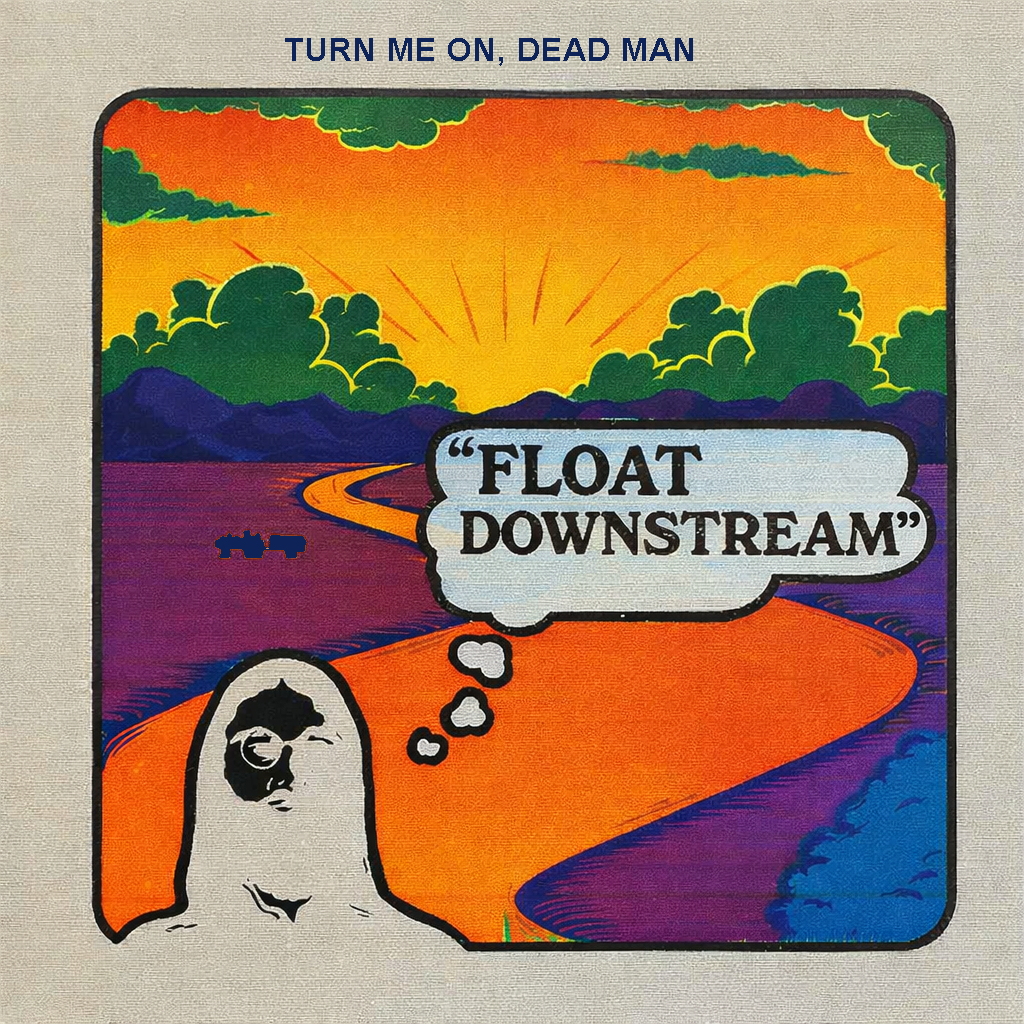
New releases from Upupayama, Elephant Stone, Las Robertas, MONOVISIONS, Bhopal's Flowers, Club of Droids, FROMME, Trigona, Wooden Overcoat, Johnny Bell, Pez Globo, DWLVS, Studio Kosmische, Ogua, and psychedelic source records. “Float Downstream” explores psychedelic music not as escape from difficult times, but as a way of navigating troubled waters.
| Time | Artist | Track Title |
|---|---|---|
| 00:54 | Upupayama | Mystic Chords of Memory |
| 05:49 | Elephant Stone | Everything Evil |
| 07:40 | Las Robertas | Everything I wanted to be |
| 11:48 | MONOVISIONS | On The Highway |
| 14:41 | Bhopal's Flowers | Miroir Miroir |
| 19:05 | Club of Droids | Fear the Wicked |
| 22:18 | FROMME | Summer Seems So Long Ago |
| 26:17 | Trigona | Divining Rods |
| 36:05 | Wooden Overcoat | Home |
| 39:35 | Johnny Bell | Departure Valley |
| 43:29 | Pez Globo | Esperando |
| 48:51 | DWLVS | Cyclone Warrior At The Doors Of Misperception |
| 55:26 | Studio Kosmische | In Search Of Magick |
| 65:12 | Ogua | Song 1 |
2026
“Float Downstream” takes its title from one of the most famous lines in psychedelic music — “turn off your mind, relax, and float downstream” — but the episode approaches that idea a little differently. In a period that often feels defined by noise, the music here doesn’t suggest disengaging from the world so much as learning how to move through it without being overwhelmed by it. Psychedelia becomes less an escape hatch than a navigational tool.
That feeling connects records arriving from remarkably different places. This episode moves from Montreal to Costa Rica, from Portland to the Hungarian countryside and beyond, yet many of the artists featured here seem attuned to a shared frequency. Repetition, motorik rhythms, hypnotic jamming, and gradual transformation appear again and again throughout the episode. Each track guides us through difficult waters.
What also stands out is how fluid the boundaries between genres have become. Psychedelic rock merges into ambient music, shoegaze dissolves into electronic experimentation, and krautrock repetition coexists with dream pop atmosphere. The shared thread isn’t genre purity but immersion. These records encourage listeners to stay inside uncertainty long enough for something meaningful to emerge from it. In that sense, “Float Downstream” isn’t about surrendering to chaos. It’s about learning how to remain psychologically afloat while moving through it.

Upupayāma is from Parma, Italy. Music from the barn.
Elephant Stone is from Montreal, Québec. Debuting in 2006, the psych-pop creation of Rishi Dhir has released six critically-acclaimed albums, toured extensively throughout North America and Europe, been nominated for the prestigious Polaris Music Prize and picked up praise from the likes of NPR, Brooklyn Vegan, Consequence of Sound, Rolling Stone, Clash Magazine and more.
TMODM: ASHA is described as your most personal record, shaped by loss but centered on the idea of hope. How did working on this album change your relationship to those songs over time? Did they evolve as a form of processing or healing as you recorded them?
Elephant Stone: I've always believed that songwriters are empaths; we're constantly processing everything around us. This record started from a place of sadness about the world, but also a real hope that things would work out.
The original working title was Elegant Chaos, inspired by a Julian Cope song. There's a line "in this elegant chaos, I stand to one side" and that feeling really captured where I was at the beginning.
But as I wrote the songs, and as life happened, everything became much more personal. At the start of writing the record, I lost a dear friend to suicide. And so as I made the album, the meanings of the songs began to shift and change beneath me.
Then, as I was coming to the end of it, my mother passed away very unexpectedly. And at that point, I looked back at everything I'd made, and I saw a completely different album than the one I thought I was making.
That's the great thing about art: it can mean so many different things to so many people, and that meaning will always change over time. When I finished ASHA, I saw hope in those songs. I saw sadness. I saw nostalgia. I saw history. All of it was there, and it was new to me.
TMODM: "Everything Evil" feels especially direct and immediate compared to some of your previous work, short and stripped back. What drew you toward that more urgent approach for this track?
Elephant Stone: I think it just came down to the theme and the message of the song. The music came first and right away it felt claustrophobic. That riff just had this intense, closed-in energy, and the song kind of told me what it needed to be.
I actually wrote about the songwriting process behind "Everything Evil" in my Substack — Rishi's Sacred Sounds — if you want to go deeper on that. But the short version is: the song called for something really intense, and I had something to say. And I figured I'd say it in under two minutes.
TMODM: After 20 years of Elephant Stone, your blend of traditional Indian instrumentation and Western psych feels natural and unified. Do those elements still feel like distinct influences to you, or do you really not think about it that way anymore?
Elephant Stone: No, I really don't think about it that way anymore. In the early days of the band, it felt pretty obvious; you could clearly hear which songs were drawing from Indian influences and which were more rooted in western pop and psych. But as the band evolved, that line just blurred.
I think the defining moment for me was "A Silent Moment" off our 2013 album. That was the first song where I felt like I could bring both worlds together without trying too hard. It just felt completely natural. And from that point on, it stopped being something I thought about consciously. It's just become a defining part of the sound of Elephant Stone.

Based in San José, Costa Rica and founded in 2009, Las Robertas have played in festivals such as Coachella, Primavera Sound, Levitation, NRMAL, Ruido Fest, Rock al Parque, Tomavistas, SWSX and Viva Pomona among others. The band has been constantly touring in Europe, USA, Mexico and Latin America and has opened shows for Pearl Jam, Warpaint and Hop Along among others.
TMODM: How do your surroundings in Costa Rica influence your psychedelic/dream pop sound? Is there a specific energy in the Costa Rican underground right now that you feel is woven into this new record?
Las Robertas: There’s definitely a big influence from the nature that our country has, it’s insane how it sometimes feels like you’re in a dream, the blue mountains that surround us, colorful tropical flowers, the rainforest, insects, animals, bodies of water, the shining sun and rain. All these elements inspire our lyrics and visual work of the band as well. We’ve been making psychedelic music since quite a long time now, but as we’ve matured as humans, the appreciation of these nature elements have grown within us more and more.
TMODM: You describe the album as “an invitation to let go and step fully into the present moment.” Does that idea come from a place of responding to the uncertain times we’re in, or is it more of a personal philosophy that shaped the record?
Las Robertas: I think the feeling of living in the present is something that is both personal and as an answer of the uncertain times for sure. It’s inevitable not to be affected by how things are now in the world. Music and making music is a coping mechanism and a channel to heal your inner self (at least in our case).
TMODM: You've been going since 2009 with different lineups. What does Las Robertas mean now, in 2026, compared to what it meant when it started?
Las Robertas: I think there has been a constant evolution that goes together among the music and on the personal side but maintaining the core, or essence of the band musically since it started back then. A lot of years have passed, and as a result of that, you feel more confident with experimenting different sounds and influences, and that is reflected in the song writing and music that we make nowadays.
Psych-rock: Portand Oregon
Brad J. - Drums
Dylan Bodnarick - Bass
Eddie Orso - Guitar/Vox
Nicholas LoCascio - Guitar
TMODM: Your debut album carries the intriguing title Vibrations From The Paper Machine. What's the paper machine?
Monovisions: The lyrics to the song happened to be written on an old typewriter, so as basic as it sounds. Those lyrics were the vibrations from the "paper machine."
TMODM: The video for “On The Highway” focuses on an old cassette player. How important is that lo-fi, analog feeling to the way you think about your music?
Monovisions: We record all of our music analog. This album was recorded on a Tascam 688 - 8 track cassette portastudio, with no post effects or edits. All recorded to tape as performed. This type of production is something we stand by, and feel it suits the music the best.
TMODM: What's next for you?
Monovisions: Now that the album is a wrap, we are starting to play shows, with our first debut show in Portland, Oregon June 14th at the Twilight Bar and Cafe.

Psychedelic Music from Montréal.
TMODM: On Poivre Rose, you bring together sixties pop, Italian western scores, and Indo-Persian instrumentation in a very cinematic way. How do you approach blending those influences so they feel like a unified world rather than separate elements?
Bhopal’s Flowers: The musical approach and songwriting on Poivre Rose differed from Bhopal’s Flowers’ previous albums. The record can be seen as a conceptual map bringing together worlds that may at first seem far apart. From an orchestral point of view, the Iranian târ, Indian sitar, dulcimer, harpsichord and Rickenbacker 12-string are assembled like a quintet, a sort of super-instrument playing in unison the theme specific to each track, in the spirit of the The Persuaders! TV theme.
The elements of Indian classical music were then integrated more deeply than in the past; some tracks are closer to the traditional music of North India than to rock. I am thinking in particular of "Morning Sun" (a bhajan taal in raga Gunkali), or "Sunset Variation," derived from raga Marwa and played over a very slow 16-beat cycle (vilambit teentaal).
Lastly, the figures that shape the world of Poivre Rose—from mythic duos such as Jane & Serge, Nancy & Lee, and Sergio & Ennio, to the mist-laden writings of Charles Baudelaire and Charles Duchaussois—naturally brought together the aesthetic of this singular record: an oriental and psychedelic western.
TMODM: In our last conversation you mentioned that archangel Metatron and goddess Saraswati were presences during the making of Joy of the 4th. And Metatron shows up again in the lyrics of "Sunset Variation" on Poivre Rose. It feels like these aren't just decorative references for you. How does the spiritual dimension actually shape your work?
Bhopal’s Flowers: It is true that "Sunset Variation," an ode to twilight, at one point refers to the archangel Metatron. Poivre Rose is inhabited by the need to act and to purify the human astral body, a crucial stage in the development of humanity that calls for urgent attention in our time. As such, it is not an album concerned with the general laws of the great spiritual architecture, but rather one that seeks to act concretely upon the soul’s radiance, much as pink pepper, saffron, or vanilla do—spices that are given pride of place on this record.
TMODM: You've sampled spoken words from Jane Birkin on "Kaleidoscope," specifically from Les Chemins de Katmandou, a film about the counterculture trail to Asia. That's a very precise choice. What was it about that particular moment from that film that felt right for this record?
Bhopal’s Flowers: The choice was far from incidental. As mentioned above, Serge Gainsbourg’s 1960s period strongly inspired part of Poivre Rose’s aesthetic. The sound of the Höfner violin bass, the timpani, and the passages in French all clearly echo his musical world. I managed to get hold of the soundtrack to Les Chemins de Katmandou, reissued on vinyl, a score Gainsbourg wrote with Vannier, his collaborator on Melody Nelson, during that same period. The film and its soundtrack became, for me, the visual and sonic mirror of Duchaussois’ book Flash I was reading at that time.
When I introduced Jane Birkin’s voice into "Kaleidoscope," the magic happened almost by itself. So much so that Blandine, who sings the lyrical vocal line at the same moment, almost seems sampled herself, as though she were part of Birkin’s dialogue in the film. As for the choice of excerpt, I find that this passage is an almost perfect mirror of the final exchange in the track "Melody" on Melody Nelson: “What’s your name? (…) Melody Nelson has red hair, and that’s its natural colour” (S. Gainsbourg in Melody) versus “Are you French? What’s your name? (…) you are free, we love each other” (Jane B. in "Kaleidoscope").
TMODM: What's next for you?
Bhopal’s Flowers: We’ll be heading to Ontario next month for a show alongside psychedelic bands we recently connected with while touring there last fall with Kula Shaker and Levitation Room. Another Poivre Rose video should also emerge soon, helping bring the album’s world to life in images and film.
It is a record that has stayed with me for several years, like a parallel presence, with its mirages and visions, while Montreal would sometimes take on the appearance of a spectral Kathmandu. It is also an album I will find hard to leave behind, unlike the previous ones, which were barely finished before they were already half-forgotten, as I had thrown myself headlong into recording a new opus.
All the more so since the next album, whose recording sessions will begin this summer, is likely to be very different from this one. Once pink pepper has been consumed, we are no longer the same: the nostalgia and memory of the first taste remain forever unfulfilled… unless we somehow manage to transform our astral body.
Club of Droids are from Stockholm, Sweden. Alive, raw, and precise. Their music explores life’s light and shadow, how it flickers through humanity, and the darkness beneath it all.
The band features Johan Bring on vocals and instruments, and Henrik Holmlund on drums. Longtime collaborators since the early 2000s, they’ve played everything from synth, obscure industrial pop to metal.
TMODM: You describe the album as emerging from sleepless nights in the Andalusian mountains, with guitars “screaming like electric spirits.” How did that setting influence the mood of “Fear the Wicked” specifically?
Club of Droids: Unconsciously, stir things up in our everyday lives and shape human history. A struggle between harmony and disharmony. What would one be without the other? A struggle between the material and the spiritual. I suppose the instrumentation itself moves in similar territories. But the environment here in Andalusia during winter — with its dry mountains, sharp cliffs, salty water, and strong sun — offers conditions that clearly imprint themselves on the music.
TMODM: You’ve been collaborating since the early 2000s across a wide range of styles. When you came together for this album, did it feel like a continuation of that history, or more like a reset with a new identity as Club of Droids?
Club of Droids: I think each album feels like a reset from what we’ve done before. It’s really about starting fresh with every song, I would say. But of course, there is a common thread in who we are and how we evolve that runs through everything. A conscious decision for this record was to use more real drums. That was actually the only thing we knew from the start. It gave the project some shape, and then it was just a matter of letting go and seeing what would emerge. Some songs disappeared along the way, but that feels completely fine in hindsight, and they might show up later in some form.
The idea for the name Club of Droids emerged playfully — it started as “Club of Druids” from our shared interest in the occult. At the same time, “droids” was appealing, like a darker flirtation with transhumanism. Previous projects moved in similar realms of thought, but included other members with slightly different directions. In general, it was more machine-driven back then, more synths, and perhaps more “pop,” in our ears if you can call it that.
TMODM: What's next for you?
Club of Droids: We already have the beginnings of a new album and around ten finished songs. It seems like it will be more broken this time, and more madness. There will also be a number of live shows this summer, which we’re really looking forward to. The summer will be spent in Sweden, in Stockholm and out in the countryside at my old forge, where I usually mix the music.
fromme is from the UK. The sound of self-possession.
TMODM: You mentioned coming off tour with The Telescopes and then turning your focus back to FROMME. Your work is produced and mixed by Stephen Lawrie. How does working on this solo project differ for you creatively? And what does Stephen bring to FROMME that you wouldn't get working alone?
FROMME: Playing with The Telescopes is an immersive, collective experience; it's about coming together to realise Stephen’s vision within that wall of sound. FROMME is the inverse. It is a process of stripping away until only the essential pulse remains. It’s solitary and focused on the mechanical side of emotion. Much of this upcoming album was written during long periods in an ICU while caring for a sick parent. That clinical, cold atmosphere—the constant hum of machinery and the emotional suspension—deeply affected my style of writing and arrangement.
Working with Stephen is built on trust. He has an unparalleled ear for the space between the notes. He brings an essential sense of objectiveness to FROMME; he knows how to take a raw idea and frame it in a way that feels timeless yet unsettling. He provides the perspective that I simply couldn’t have while being so deep inside the tracks.
TMODM: Your bio on Bandcamp is concise: "The sound of self-possession." That seems like a very deliberate choice for a solo project. Does that mean making music on your own terms or does it mean something else?
FROMME: It is a very deliberate choice. To be self-possessed is to be in full control of one’s own frequency, regardless of external chaos. In the context of FROMME, it means the music doesn’t seek permission to exist. It’s about making music on my own terms, but also about a sound that is grounded, singular, and perhaps a bit detached.
TMODM: You've put out two tracks from your upcoming album that seem to cover a lot of ground. What else can we expect from your upcoming album? What ties it all together?
FROMME: While "Summer Seems So Long Ago" and "Black Dog" inhabit different spaces, they are tied together by a sense of inertia. The album explores the tension between stillness and relentless forward motion. You can expect more of that mechanical, motorik drive—music that feels like a machine moving through a dream.
Trigona is from QLD, Australia. Psych rock recordings featuring lots of fuzz, delay, swirly effects and that motorik beat all the kids are talking about.
TMODM: You’ve been releasing music pretty steadily over the past few years, and I’ve had the chance to feature a lot of it on Turn Me On, Dead Man. Listening to Radiant Point, do you hear it as a clear evolution, or does it feel more like you’re refining the same core idea over time?
Trigona: I think there's a bit of an evolution with the new album. There's obviously still similarities with my past songs, but I've expanded to include baritone guitars on this album which I've never used before and generally I think I've become a little bit more adventurous with my bass playing.
TMODM: You’ve mentioned in the past wanting to explore things like synths and different sounds, and on Radiant Point there’s a real interplay between synth bass, guitar layers, and rhythm. When you’re building these tracks now, are you thinking more in terms of arrangement and composition than you were earlier on, or is it still driven by that initial jam/idea-first approach you talked about before?
Trigona: I'd say I've become a little more conscious of arrangements than I have been in the past, but most things start with a bit of a jam on an idea, and then working out other parts that fit with the original section. I still like to include a real jam heavy song on an album when I can, and on the new one that's probably "Divining Rods" with the real improvisation heavy section in the first part.
TMODM: "Divining Rods" is described as a song of two halves, shifting from a space-raga with bongos into a high-velocity rocket launch. When you’re working as a one-man project, how do you approach shifts like that? Do those transitions happen naturally while you're jamming, or do you have to map out the track before you record it?
Trigona: "Divining Rods" was recorded at the end of 2022, and it was originally about 20 mins long. I very consciously set out on that occasion to record something that was very long which combined two differently paced pieces of music. I obviously edited it down to a more manageable 10 minutes but I think the original intention when I recorded it is still very much there. I think it started out with the basic bongos and then I built guitars and mellotron sounds around that with the bass guitar really taking on the lead/melody instrument in the first section. It was pretty much built up through jamming along with it each time I added a new layer on.
Based in the rain-slicked creative hub of Portland, psychedelic pop outfit Wooden Overcoat is the sonic brainchild of multi-instrumentalist Brant Hajek, rounded out by Dillon Glusker on bass, Mac on guitar, and Brian Levin on drums and backing vocals.
TMODM: You started Wooden Overcoat in 2020, recording songs you'd written in your late teens. That's a significant gap. What happened to those songs in the intervening years, and what made 2020 the moment to finally go back to them?
Wooden Overcoat: I was always primarily a drummer, but in one friend-group we had a drummer who didn't know how to play anything else. I was comfortable on guitar so I took up playing bass to fill a void. In those years I was co-writing songs with my good friend and learning the ropes mostly by copying The Beatles. I had several songs I wrote that I was happy with that we played as a group, badly at that. We broke up when we were all just about 20 years old, with no recordings to show for it.
After that, I returned to the drums and played various bands in town (Portland) but I never forgot about those songs. Eventually I took a break from performing altogether—an indefinite hiatus. I sold my drums and a bunch of gear, but I kept an acoustic guitar and never stopped playing. When lockdown occurred I noticed I was starting to feel inspired again, hearing melodies and harmony in my imagination, which drove me to buy some microphones and begin amassing the gear I would eventually use to record Home. Before that time however, I recorded an EP of 5 other songs I already knew were finished, just for practice and the pure joy of creating music. You cannot find these songs anywhere online.
TMODM: You performed every instrument on the EP yourself, then assembled a full live band to play the songs out. How did that transition go? Has the music changed now that it's being performed by a group?
Wooden Overcoat: The transition from solo recording to a band setting is very different. I found that with drums and other instruments, I sometimes need to adjust the key of a song I comfortably played on an acoustic guitar to be higher. The other thing is, I wrote everything on the Hello Sunbeam EP in 2024, and getting this band together earlier this year I realized that I would do some things differently with the songs if I wrote them now.
I have some new gear that I didn't have before, namely a few guitars, and I also have new ideas about what's exciting and what I would like to hear from a band like my own. Time and new experiences caused me to expand on what I recorded, so the way we play them as a band is a little different. I like to think of it as the natural evolution of what I was already up to.
TMODM: The video adds another layer to the song’s dreamlike quality. How closely did the visual concept develop alongside the music, and what did Francesca Bonci bring to the piece that surprised you?
Wooden Overcoat: It was really cool connecting with Francesca because she already works with other artists who are generally aligned with what I'm doing, and her visual aesthetic is kind of a perfect match. She does something that reminds me of liquid light running through a grainy VHS tape recorded on a handy cam. It's a perfect mixture of 60s and 90s elements brought to the future, which I very much resonate with.
She lives in Italy so I could only communicate via email and we're on very different schedules. I can't really speak to her process but she told me many times she was very inspired by the song. I was very happy with what she made with no notes. Something that surprised me were the cartoon-like images added in. I think they are super cool and fun.


Working from within the lineage of American Primitive music but drawing equally from heavier experimental influences, Johnny Bell juxtaposes traditional banjo technique with acoustic drone, recursive patterns, and layered sonic textures, foregrounding the instrument’s darker and more resonant possibilities. Based in New Mexico.
TMODM: The liner notes describe a specific mic placement, capturing the back of the banjo pot to get at its low end, so the listener feels like they're inside the instrument. How did that approach shape the way you recorded and arranged these pieces?
Johnny Bell: I've always been drawn to lower register banjo tunings — darker, moodier, further from the instrument's traditional sound. Going into preproduction, I told Andrew Weathers I wanted to capture a banjo tone I hadn't heard on any other record. Something warmer, rounder, more resonant. He just said "I have ideas." When we got into the room he positioned a microphone behind my playing position, aimed at the back of the instrument, and that was it — that was the tone. It gave the banjo tracks a density that became the foundation everything else was built on. If we'd gone brighter and thinner, the compositions would have been swallowed by the layers of drone and synth.
TMODM: You expand the idea of “mountain music” beyond Appalachia to the Rocky Mountains, which gives the record a very different emotional tone, more stark and desolate. How does place shape the way you think about the banjo and the kind of stories or moods you want it to carry?
Johnny Bell: The music that resonates with me most always has a strong sense of place — something in the tones, the timbres, even the instrument choices that puts you somewhere specific. On my last record I used ambient field recordings to do that work. But listening back afterward I realized the banjo was already doing it on its own. It's such a singular sound — it bypasses your brain and goes straight to some collective memory of a place that may or may not have ever existed. It teleports you to Appalachia and to America's rural south. With Mountain States I wanted to take that instinct and stretch it geographically — pull the banjo out of its diasporic home and see what it sounds like against a more desolate, high-desert landscape.
TMODM: Mountain States feels like a culmination of something you spoke of in our last conversation. You mentioned wanting to make a record "somewhere between American primitive and progressive metal." Now that you've recorded Mountain States, does it sound like what you imagined, or did it become something different in the making?
Johnny Bell: It's funny, that conversation was the first time I'd actually articulated that intention— combining American primitive guitar music with heavy, experimental metal, using a banjo. It sounded unlikely even as I was saying it. But once it was out there I couldn't go back, and I carried that intention all the way through preproduction and into the recording session. I tried not to hold too tightly to any specific expectation of what that would sound like — partly by design, partly because I knew I was working with Andrew, who is a genuine sonic wizard. I trusted him completely. The result far exceeded whatever I'd let myself imagine.
Claramente una claraboya en el claroscuro de toda clase Pez globo pincha cuando lo sacuden
Consiguen delfines jugando húmedos venenos de su cuerpo. Based in Argentina.
TMODM: Pez Globo began as a home recording project during a pause with Los Acidos and eventually grew into a full band. How did those early solo recordings shape the identity of Pez Globo, and what changed once the project became a collaborative group?
Pez Globo: The truth is, those early productions were made with the intention of keeping the creative flow going. While we were messing around with Los Acidos, that energy was channeled into that project. With that outlet no longer available, I needed to find another excuse to keep exploring songwriting and music production, two activities that are fundamental to my mental health. In fact, I sometimes wonder how non-musicians manage to endure the hostility and harshness of the world, because it's truly a haven where you can disconnect from everything and even get to know yourself more deeply.
Besides, of course, it's an extremely fun (sometimes a bit too laborious) and enriching activity. You create something from nothing. It's truly wonderful. Whenever I can, I try to encourage people to delve into music and songwriting. With Pez Globo, the material is always whatever comes out in the moment; nothing is ever planned, so that's why the releases are quite different, although there's something that binds everything together: a love for music with a more psychedelic edge. The idea is always to explore the sound itself as well, to look for new sounds, rhythms, melodies, timbres, forms. I think I get a little carried away, haha.
As for the change in that aspect when it became more of a group project, the truth is that it never fully solidified. There were two instances where that happened: after Segundo Extendido, when we recorded a double-sided single, "Ondas Turmalinas/Andante del Himalaya," which were compositions born from improvisations while we were rehearsing, which we released during the pandemic—quite a challenge. But the pandemic separated us, and we couldn't continue. And the other instance is currently, when we've only managed two live shows, and so far we haven't been able to put together a release, since our schedules don't align, so we're looking to go our separate ways. I'm currently considering transforming Pez Globo into a one-man band, using drum machines, sequencers, loopers, and that kind of equipment for live shows.
TMODM: In our last conversation, you mentioned wanting to record more and do a live session. Now that Pez Globo is out playing shows, sometimes even inviting friends to jump in on the tambourine. How does that live energy translate back into the studio? Are your new recordings becoming more improvisational as the band spends more time playing together on the "magic bus"?
Pez Globo: For upcoming releases, I'm thinking of inviting friends to record on different compositions I come up with, or even improvising over existing ideas, creating spontaneous and casual recordings. It's becoming increasingly difficult to coordinate schedules and commitments. The same goes for live shows.
As I mentioned in your previous question, perhaps a one-band format, inviting different musicians to contribute at various points in the show, which would initially be structured around a personal project. This is all for practical reasons. I think it will be easier and more fun that way. For example, the rhythm could come from a drum machine (I'm currently using an Akai MPC 1000), I could play guitar and sing, and then invite someone to add a synthesizer and another person a tambourine. At another point in the show, someone else could come up to play acoustic drums, I could switch to a keyboard, someone else could join in on guitar, and yet another person could sing backing vocals. And I'd use that same logic for other parts of the show. That plan more or less.
TMODM: You've released a remarkable amount of music in a short stretch, several releases in 2024 and 2025 alone, moving through quite different territory each time. Do these feel like separate statements to you, or more like parts of a single unfolding work?
Pez Globo: Thank you, creating music, producing, and experimenting are truly something I enjoy immensely. As I mentioned, sometimes experimentation goes too far and I ended leaving things out that might not be necessary. On my last album, I think the endings ended up being too long, or that I left out some tracks that aren't very good or noteworthy. But I don't like leaving things out; everything seems quite interesting to me, and I feel bad about leaving them aside.
I don't see my releases as separate parts of my musical interests. I think, as you say, they're more like parts of a single work that develops and unfolds, trying to encompass everything that interests me and arises, without much control, really. Pez Globo is never about making something that people will like, but rather about exploring and, as much as possible, innovating a bit in territories that I feel are still undiscovered. Since I really like psychedelia and the song format, several tracks with a pop or more conventional feel sometimes emerge, but it's more out of love for that format than a desire to be commercial. I´m not looking for a hit or a single. It's really all an excuse to make music that I'd like to listen to myself, trying not to limit my curiosity about new sounds, textures, forms, and other musical aspects. I can perfectly imagine, for example, a release where everything is music made with orchestral instruments. Or something that sounds like music for a film. My musical tastes are incredibly varied, and that inevitably comes through in my compositions.

Founded The Iditarod in 1996, Black Forest/Black Sea in 2003 + Dire Wolves in 2008. Joined JOMF in 2013. Started The Heavy Lidders in 2019.
Pome Pome Tones label + radio show.
Former label owner of Magic Eye Singles + Secret Eye Records. Also on records from Kemialliset Ystävät, Avarus, Es, Fursaxa, Christina Carter, Gravenhurst, Jeffrey Alexander-Andrea Belfi-Stefano Pilia Trio.
TMODM: I’ve played tracks by The Heavy Lidders and Dire Wolves on Turn Me On, Dead Man over the past few years. When you switch between projects, do you think of them as distinct or are they all part of one ongoing flow for you?
DWLVS: My approach to playing is the same regardless of which band or solo recording I'm working on—it's very much one continuous flow. But the difference is who I'm collaborating with on each thing. Improvisation is wholly listening, so the playing and contributions from other band members will absolutely affect what I do, almost always for the better. Interacting with other players is the most joyful and exciting thing for me about tinkering with music anyway.
TMODM: You’ve been releasing some archival material lately, including this latest DWLVS single. What’s been driving that? Is it about revisiting older work or more about making sure these recordings finally find their way out into the world?
DWLVS: That "Clear Drop" 7" was released on a Czech label called Stoned To Death back four or five years ago. We met them when we played a show together in Prague in 2019. Very recently, they found another box of the vinyl and sent them over to me, so I put it up on Bandcamp—its a great single and you know, music doesn't have to be "brand new" to be enjoyed 🙂 But to sweeten the leaf, I included a pair of The Fall covers with the download version.
TMODM: "My New House" is a standout "bonus bit" on this release. Could you tell me a little bit about the origin of that specific track? What made you want to include it on this release?
DWLVS: In 2018, I moved from San Francisco to Philadelphia—landing in a bucolic reconstructionist shtetl called Mt Airy. I wanted to sing about my new house here just as Mark E Smith would have done. This came out on a very-limited (42 copies!) lathe-cut 7" single in 2019 and never before available digitally, so why not spread around a few rarities?

Alter ego of UK musician Dom Keen, label boss of the Studio Kosmische label.
TMODM: Electronic Meditation for Inner Space Travel feels like a guided journey. When you’re creating something like “In Search of Magick,” do you have it mapped out or do you let it unfold on its own?
Studio Kosmische: Both, for sure. This album was a little mapped out to begin with, then letting the music lead the way was an important part of the process.
I knew I wanted to do a project with Ivan Bursov that was more of a full collab than just him guesting on part of an album. He’s so damn talented I wanted to make a full LP—so this is how it transpired. To begin, I created two long form drones using a drum machine pattern with an old Roland TR-77. The drones were made with a Raagini electronic tanpura, along with treated organ and some other bits and bobs. I sent these audio sketches to Ivan Bursov who then recorded his layers of inspired, freeform saxophone over the top.
I treated some of the saxophone playing, running it through an envelope follower and filter, adding delay, reverbs etc. Then collaborated with John Parkes to help rebuild the backing behind Ivan's playing. We added percussion, real drums, bass, acoustic and electric guitars, Fender Rhodes piano, a few other instruments. Some separate sessions of sound design happened at some point to add to the two main compositions, such as the intro track, "The Sorcerers Gather."
Mixing the two sides, however, turned into quite a drawn out affair. I think it was a little over two years. Elements changed, music was removed, some put back in. I’m not quite sure why it took so long as the initial idea was clear once Ivan was involved—I guess it just had to take its time! Looking back it was perhaps a bit of an undertaking mix wise, as both sides remained solid slabs of 20 minutes. But all the time taken was worthwhile in the end. I think roughly another album and a half were created in that period, and it is best to not get tired or fatigued by overworking on something.
The feeling of a guided journey is perhaps more dictated by the final mix than anything else—the chiselling, organising aspect of the process, until both sides felt like a single, complete story.
TMODM: You’ve worked extensively with analog instruments and kosmische sounds. How do you approach the balance between technical sound design and something more intuitive or spiritual when composing?
Studio Kosmische: It’s all intuitive/spiritual for me. I tend to not really think when I’m working, be it playing or mixing. The only cerebral part that maybe helps is sitting back with pen and paper, listening to an unfinished piece whilst making notes on anything that sticks out or could be improved—to be used as reference for when I next work on a mix. As soon as my brain gets too involved, I start to make uninspired choices. The application of reverbs, panning, fades etc. in the mix are intuitively done… The technical part was just learning all the tools so I don’t have to think!!!
Ogua ("Oh-gwa") is from Morgantown, West Virginia.
Jeff - Guitar, vocals
Donnie - Guitar
Paul - Bass
Evan - Drums, vocals, effects
Residing at 123 Pleasant Street, finding order in the chaos.