
A wide-ranging set of psychedelia. Recent releases from The Welly Welly Wells, Maya Ongaku, The Green Pajamas, navā, Warp Transmission, Spooky Eyes, Score, The Taps of the Holy Trinity, Thee Strawberry Mynde, Timoti la Moto Casco, and Mirage.
| Time | Artist | Track Title |
|---|---|---|
| 00:36 | The Welly Welly Wells | Lies |
| 04:35 | Maya Ongaku | Astral Echoes |
| 09:57 | The Green Pajamas | My Lady Lily Anne |
| 18:35 | navā | Rain Flower |
| 21:52 | Warp Transmission | This Is Not Our Way |
| 33:46 | Spooky Eyes | Run |
| 37:11 | Score | Sail Across The Sky |
| 45:41 | The Taps of the Holy Trinity | Slow Ghosts |
| 48:12 | Thee Strawberry Mynde | Actions |
| 51:29 | Timoti la Moto Casco | Manglar |
| 55:49 | Mirage | Peacewave Generator |
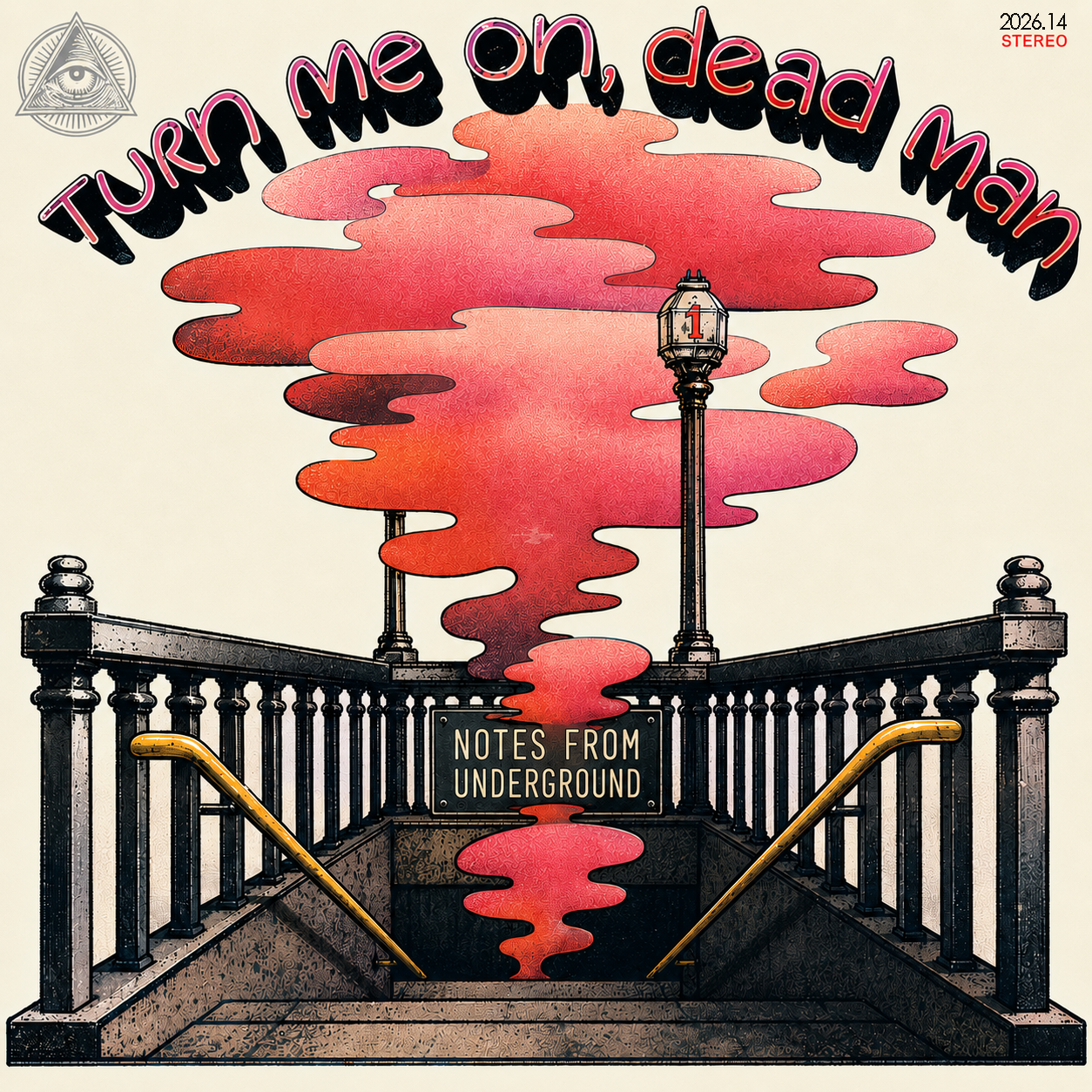
2026
Christian Bland from the Psychedelic Rock Band The Black Angels and Recording Engineer , Producer and Songwriter David Galvan started writing music during The Lockdown as a result The Welly Welly Wells!
TMODM: I’m planning to play “Lies” from the new Brethren EP. What came first with that song — the lyrics, the guitar sound, or the basic musical idea?
The Welly Welly Wells: I came up with the guitar part on “Lies” and Christian started singing his lyrics to it about lies and things we believe in, like in a Liam style.
TMODM: The four main tracks on Brethren have very different titles: “Lies,” “Texas State Cemetery,” “My Friends,” and “Paeacusion Illusion” (and the bonus track “What Would You Do?”). Were these songs written as a group for the EP, or did they come together from different periods of writing?
The Welly Welly Wells: Yes, all the songs are over a period of two years. We just write organically, I guess — whatever catches our ear and sounds alleyway tough, lol, like you were faced with the Clockwork gang.
TMODM: You’ve described The Welly Welly Wells as having more of a post-punk and European alternative-rock influence than some of Christian’s other projects. Is there one record or artist that particularly influenced the sound of Brethren?
The Welly Welly Wells: We both like post-punk, like Joy Division, so we try to stay in that lane.

Hailing from the seaside communities surrounding Enoshima, a small island located 50 km southwest of Tokyo, maya ongaku is a ragtag collective of local musicians whose brand of earthy psychedelia transcends widely beyond the roots of their inner souls. The name derives not from any kind of ancient civilization, but rather a neologism defined as the imagined view outside one’s field of vision. The band—currently a trio of Tsutomu Sonoda, Ryota Takano, and Shoei Ikeda—finds sanctuary at the Ace General Store, a beachy vintage shop and salon-like space just hidden from sight from the bustling, touristy riverside Subana Street. Between discussions on music and art, curating the vinyl section and manning the register, and chatting up with locals young and old, the members find time to jam and record their spontaneous ideas in the studio tucked away in the back. It’s in this unlikely setting where maya ongaku finds its origins, the culmination of what Sonoda describes as 自然発生 (shizen hassei), meaning spontaneous generation, or the supposed production of living organisms from nonliving matter.
TMODM: “Astral Echoes” is about waiting for inspiration to arrive rather than chasing it. How do you know when an idea is worth following?
Maya Ongaku: I don’t think we can always know beforehand whether an idea is worth following. For me, the important thing is to remain open enough to notice when something appears.
Sometimes a very small sound, a feeling, or an unexpected coincidence can contain something that wants to develop. Rather than deciding immediately what it means, I try to stay with it and see where it leads. If it continues to resonate without forcing it, I feel that it is worth following.
TMODM: You describe your creative process as shizen hassei (“spontaneous occurrence”). How did that idea shape Nothing Space Music?
Maya Ongaku: We didn’t share a specific concept for the album with the other members of the band. Instead, we focused on listening to and packaging the music that the music itself called forth.
During improvisation, melodies kept appearing one after another. Our process was to listen closely to those melodies and pick up the ones that continued to resonate with us. It was almost like giving names to constellations that had no names before — finding connections between sounds that had appeared spontaneously and giving them a form.
In that sense, the album was not something we designed beforehand. It emerged through the process of listening, selecting, and connecting what had already appeared.
TMODM: You built Nothing Space Studio near a seaside shrine in Shonan to make this album. What did that particular place bring to the music?
Maya Ongaku: In Japan, beautiful natural environments often remain around Shinto shrines. Throughout its long history, Japanese spirituality has continually turned its attention toward nature.
We didn’t want to make music in a controlled space that was completely separated from the environment. We wanted the music to remain open to whatever was happening around us.
The wind, insects, birds, waves, and the changing atmosphere of the place were all part of our experience there. I think that sense of openness became an important part of the album.
TMODM: After several years of touring, you became interested in silence and developed the idea of “Nothing Space.” What does “Nothing Space” mean to you?
Maya Ongaku: For me, “Nothing Space” is not simply an empty space or the absence of sound. It is a space before things are separated into names and meanings — a kind of openness in which past, present, and future can coexist.
After spending years touring and constantly being surrounded by sound, I became increasingly interested in what exists before and after sound. Silence made me realize that music doesn’t necessarily begin with a sound. Sometimes it begins with the space that allows a sound to appear.
“Nothing Space Music” is our attempt to make that invisible space audible.

Formed in 1984 by Jeff Kelly and Joe Ross, The Green Pajamas are Seattle’s answer to the Paisley Underground scene. They rose to college radio fame with 'Kim The Waitress' and have spent over 40 years releasing 30+ celebrated psychedelic and indie rock albums.
TMODM: I’m planning to play “My Lady Lily Anne,” which is one of the longer and more expansive tracks on When Fever Let Me Dream. How did that song develop, and did you know from the beginning that it was going to become such an expansive piece?
The Green Pajamas: I’m happy you are going to play that one, thank you!
I wrote the original song back in the early 1980s. It had been rattling around the back of my mind ever since — you know, I would think about the melody and chorus every now and then. With this new album, it just seemed to fit. To sort of fill in a space I felt was missing.
When I rewrote the lyric so that it pertained to my life with my wife, Susanne, I just wrote the amount of verses I needed to tell that story and, with the slower pace of the track, which is very much inspired by early classical music, I think it just had to be long. So, yes, I wanted it to stretch out a bit.
I like the long, medieval sort of melody: I accentuated it with the Indian oboe (shehnai) part as I couldn’t always hit the high notes of the original melody. So the shehnai plays those bits and, along with that droning tambura sound, adds to the vaguely ancient music vibe.
TMODM: The album moves between concise psychedelic pop songs and much more spacious passages. When you were putting When Fever Let Me Dream together, were you consciously trying to make a record with that kind of range, or did that emerge from the songs themselves?
The Green Pajamas: No, I think it came more from the songs themselves. Though, as I became aware of what songs I wanted to use, I started looking at it, maybe a little bit more conceptually, especially in the sense of the overall sound.
TMODM: The album opens with the brief “Pastyme with Good Companye” before going directly into “My Lady Lily Anne.” What made you want to begin the record that way, and are those two pieces meant to be heard as connected?
The Green Pajamas: Yes, well it’s no secret I’m often inspired by that other “ancient music,” 1960s pop 🙂 So, I like those sorts of touches — little introductions, sound effects, etc. And then I’ve always liked that Henry VIII song. So, it just occurred that it might be a good title to kick off a record with, and also flow right into the droning intro of “My Lady.” Originally I was even going to use a 16th-century spelling, like, “My Ladye, Lily Anne”… I should have done that, actually!
It’s always a kind of fun challenge to try to get close to early music sounds with digital instruments. (I love Dead Can Dance’s first 4 or 5 albums, though I know, of course, they must have used all acoustic instruments for the songs where those things pop up…)
TMODM: “The Lucy Parade” was chosen for the advance EP and video, but When Fever Let Me Dream has a lot of very different moods across the album. What made “The Lucy Parade” feel like the right introduction to the record, and is it representative of the album in your mind or deliberately just one side of it?
The Green Pajamas: Well there is a lot of variety on the record, so when some of the label folks thought it would be a good choice, I said I was fine with it.
It tends to strike a lot of people as very “catchy.” Now, with a slight bit of perspective, it is probably the least representative track of the record, as a whole. But I don’t see that as a problem, it is a good song and it certainly has its fans!
We’re just now talking about a new digital EP with “Queen of Arrows” at the forefront, which most likely — if I’d been pressed for my opinion — would have been my choice for the initial single. So we’ll see how that pans out…

navā Sanskrit/Hindi (new) and Persian (melody/song) is the Naarm based duo comprising Mohan Veena player Poly Varghese and Belgian guitarist Alec Ilyine on acoustic steel string and Japanese Taishogoto.
Their debut release Rainflower is a true mix of different cultures and ideas expressed through improvisation.
Poly Varghese, based in Australia and born in Kerala is a virtuoso of the Mohan Veena (Indian slide guitar), and disciple of Grammy Winner Vishwa Mohan Bhatt, known professionally as V. M. Bhatt.
Trained in both Carnatic and Hindustani traditions, he blends classical forms with jazz, blues and global styles in thoughtful, detailed improvisations.
The Mohan Veena consists of 20 strings and is held in the lap while playing with the total 'stringspull' to be in excess of 500 pounds. This rare instrument is played by very few people only and is highly vibrant and melodious.
Alec Ilyine is a Belgian musician, sound engineer, and multi-instrumentalist, known for his exploration of diverse musical traditions. He plays a wide range of stringed instruments, including 6- and 12-string guitars, Ud, Cavaquinho, Charango, and bass guitar.
He holds a Master’s degree in Music for Jazz Guitar and a Teaching diploma from LUCA School of Arts, Campus Leuven. He has pursued further studies in Indian music, Flamenco and Middle Eastern music. As a musician he tries to create an environment where analog meets digital, where acoustic sounds (both environmental and instrumental) coincide with an electronic eco-system.
Both skilled improvisers and solo artists in their own right, Alec's knowledge of Indian Classical Music and Poly's intuitive ability to adapt, allows for space and magic to happen.
TMODM: You both come to improvisation from very different musical backgrounds: Poly through Carnatic and Hindustani music and Alec through jazz, fingerstyle guitar, and other traditions. When you first began playing together, did you have to develop a common musical language or did that communication happen fairly naturally?
Poly: When Alec first approached me, I was genuinely curious and happy to listen to what he had to say. I have always welcomed collaboration with musicians from different genres and backgrounds, because I believe every encounter brings a new perspective and opens another door into music.
We spoke briefly over the phone, and I invited him to come stay with me so we could spend some time together and explore music without any pressure. When he arrived, he very quickly became part of the family. We spent long hours — sometimes day and night — playing, experimenting, talking and discovering where our musical ideas could meet.
For me, the collaboration grew beyond music. It became a meeting of people, cultures and emotions. We spoke about many things, shared experiences and gradually developed a sense of trust and familiarity. That human connection became the foundation for everything we created together.
I was also comfortable with Alec because of his deep engagement with India. He has travelled there several times, listened extensively to Indian music, explored different musical traditions, and spent time with people from different regions and cultural backgrounds. He wasn’t simply interested in the sound of Indian music; he had made an effort to understand something of the culture, its people, and the emotions that live within those traditions. That gave me a natural sense of connection with him.
Alec also has an understanding of several Indian ragas and their emotional character. I might begin with a melodic idea on the Mohan Veena, and he responds through the harmonic language of his own musical tradition. I find that relationship particularly beautiful: the melody can remain rooted in one tradition while the harmony opens it towards another.
Alec: Although we come from very different musical and cultural worlds, we discovered that our artistic wavelength was remarkably close. Our collaboration did not emerge from trying to force two traditions together. It grew organically from friendship, trust, listening, and mutual respect.
Perhaps that is what makes the music special. Before we became collaborators, we became comfortable with one another as human beings. From that foundation, the music found its own direction and some beautiful and unexpected compositions began to emerge.
TMODM: The name navā can mean “new” in Sanskrit/Hindi and “melody” or “song” in Persian. What did that double meaning suggest to you about the project, and did it offer a guiding principle for how Rainflower should sound?
Alec: As you said, Navā is a Sanskrit and Hindi word meaning “new.” In Persian, navā is associated with melody, song, and musical expression. For me, that combination was very meaningful: something new, a new melody, and even a new journey through music.
But rain also has two very different faces, and that contrast was central to my idea for Rainflower.
Poly: For someone comfortable and secure, rain can be incredibly beautiful. It can be romantic, refreshing and joyful. It nourishes the earth, brings fertility and creates new life. But for people living in vulnerable circumstances, rain can also bring fear. It can mean flooding, destruction, displacement and loss. So the same rain that gives life to one person can bring pain and uncertainty to another.
That is why Rainflower felt like the right name to us. A flower represents beauty, growth and creation, while rain is what allows that flower to emerge. But rain itself can also carry sorrow. In that sense, there is both beauty and pain within the same image.
So Rainflower is not simply a composition about rain. For me, it is about the many meanings that rain can carry — life and destruction, happiness and sadness, beauty and pain, hope and longing. And through Navā, we were trying to discover something new from all of those emotions.
TMODM: I’m going to play “Rain Flower,” the title track and closing piece on the album. What was the inspiration behind that composition, and what made it feel like the right way to bring Rainflower to a close?
Poly: When we developed Rainflower, I wanted that idea of newness to be reflected in the music itself. The composition is rooted in the Indian classical raga Amritavarshini, a raga traditionally associated with rain. The name itself carries a beautiful meaning: Amrit refers to ambrosia or nectar, and Varshini suggests something that pours or showers. So there is an image of nectar flowing from the sky, rain as something that gives life to the earth.
Alec: Musically, Amritavarshini has a very limited collection of notes — Sa, Ga, Ma, Pa, Ni, and Sa. Because of that, there are certain limitations when you begin to build harmony around the raga. I found ways to work within the raga while bringing my own harmonic language, guitar tradition, and a broader world-music sensibility into it.
Poly: Alec’s harmony opens another dimension around it. The rhythm, melody, and harmony come together to express these contrasting emotions.
I don’t see Rainflower as representing just one emotion. The album moves through many different emotional landscapes: happiness, sadness, longing, farewell, and ecstasy.
For example, Evening Bird carries a deep sense of sorrow and farewell, while Jog has a much more ecstatic energy. So Rainflower represents the album as a whole, rather than a single composition or feeling.
For me, rain itself is a beautiful metaphor. It can be romantic and life-giving, but it can also bring sadness, fear, and pain. In the same way, the album moves between different sides of human emotion.
Alec’s harmonic contribution was also very important. His understanding of harmony brought another dimension to my melodies, and much of the richness and beauty of the compositions came from that musical dialogue between us.
So Rainflower is really an emotional journey like rain, constantly changing, revealing different colours and feelings.


Warp Transmission Tampere, Finland. Warp Transmission is a freak accident, the weirdo process ultra, a travel void of reason. It's spaced out, stoner, psychedelic, wastoid, heavy 'n' heady ROCK. It's about riding blind the primal urge, living the archetype, and always rocking out with an excess of noise, burning some bridges and crossing a couple abysses along the way. IT IS FINISHED BURN EVERY FLAG
TMODM: There’s an eight-year gap between The Process Ultra and Excess Currents. What was happening with Warp Transmission during that time, and how did the band’s approach change when you came together to make this record?
Warp Transmission: Alright, this is a good opportunity to shed some light on this matter. Actually, Warp Transmission ceased to exist in 2019, and the “new” LP was recorded a few years before that. So this is all just a dead signal resonating… but the message is still valid! It’s a solid album and it was good and cathartic to finally get it out.
I don’t know if we had any conscious plans other than to make it more trippy and expansive sounding, and just a more well-rounded album of space/psych/drug rock. About half of the material dates back to The Process Ultra times after all. Having recruited a new drummer, Tommi, back then definitely opened some possibilities, cos he’s absolutely phenomenal on the skins.
TMODM: Excess Currents was recorded at Black Floyd’s Analog Studio. What did working with Tapio Lepistö and an analog-studio setting change in the way you captured the band’s sound?
Warp Transmission: Well, it was a welcome creative break from recording everything at the rehearsal place, just going to spend a weekend with a familiar guy at the helm, such a sweet host too. More time to get in the mood… and to tell the truth, the session’s a bit of a blur!
Tapsa did a bang-up job though — I’m more of a “means to an end” kind of guy and analogue itself does not automatically render everything better, but when you have a skilled person who knows his/our shit… this was an opportunity not to pass on. Compare it with the debut album and you’ll hear the difference.
TMODM: The short pieces on Excess Currents make the album feel almost like one continuous transmission rather than simply a collection of songs. Was there a larger concept or atmosphere you were trying to create across the record?
Warp Transmission: Yes — all of the above! There’s the intro and outro reprise which makes it all come back together, I was always a fan of those. Those synth interludes were indeed added to create a loose feel of ongoing theme in the listener’s head. I like that too. Not to mention they’re good for filler, ha ha!
Excess Currents is not a concept album per se, but there are always some connecting threads running through the lyrics. In Warp Transmission’s case it’s mostly escapism and alienation imploding into full-on apocalypticism/eschatology/paranoia. I also seem to have a habit of trying to force a conceptual feel afterwards to see how it ends up, just making the pieces fit.

Psychedelic Power Trio from Tasmania, Australia.
Jude Hastings: Guitars, Vocals, Percussion, Harmonica
Piper Rayner: Electric Bass
Jaxon Bassett: Drums
TMODM: Spooky Eyes started as Jude’s solo project before Piper and Jaxon joined and the sound became much heavier. What did each of you bring to the band that pushed it toward the sound we hear on the album?
Spooky Eyes: The first iteration of the band came together shortly after the inception of Spooky Eyes by Jude. The original line-up was a lot larger, two guitarists, a keys player, and we were much more heavily inspired by the dreamy heyday of West Coast psychedelia, more in the vein of bands like Kaleidoscope or The Music Machine. That iteration only lasted a handful of shows before the members dwindled down to just me and Jude.
When Piper joined the band we realised as a trio we had a lot of sonic ground to cover. We started looking towards our favourite power trios à la The Jimi Hendrix Experience, Blue Cheer, Sir Lord Baltimore. The sound quickly shifted into the more gritty early ’70s proto-metal/acid rock feel you get on the album, of course keeping a lot of those psychedelic veins pumping through from the start. We try hard to honour the source material rather than parody it.
TMODM: I’m going to play “Run” on Turn Me On, Dead Man. How did that song come together and what made you decide it should open the album? And what drew you to tackle “Psychotic Reaction” by the Count Five on this album?
Spooky Eyes: “Run” came about fairly early on in the three-piece. It’s definitely one of Jude’s love childs. He came to the rest of us with the song pretty much already fleshed out. We definitely road tested it a lot but it’s one of our only songs that hasn’t really changed a great deal over the years. It’s catchy, to the point and a lot of fun to play.
I think it’s a great mission statement song for the first track on a first album — high energy, lots of movement, and it has that driving kind of “we’re coming to get ya” feel to it that I think does a good job luring you into the rest of the album. We all get a little moment to shine musically on the song too.
The Count Five is another great West Coast band we listen to a lot. “Psychotic Reaction” is easily one of the very great garage songs of all time. We wondered what it’d sound like heavied-up a little bit, focusing in on that awesome main fuzz riff. It was a staple of our live shows for ages and we thought it was one of our covers that hit the mark well enough to be put to tape.
TMODM: You’ve already played everything from smaller rooms to support slots with Jack White, Foo Fighters and Wolfmother. Given how Spooky Eyes seems built around live energy, has performing on those different scales changed the way you write or arrange songs?
Spooky Eyes: Our live show is pretty much always all gas, no brakes (sometimes to a fault haha). So we haven’t really had to change much depending on the scale of the room, and we don’t really take that into account when we’re writing either.
We’re normally the loudest band on most lineups we play, so we’re just as comfortable playing a sweaty 100-cap room as we are opening a stadium show for Fooies. If anything, we get a bit more flashy with our stage presence when the shows get bigger. That kind of thing goes to your head a little bit hahaha.

Score is from Newcastle Upon Tyne, UK.
TMODM: You’ve mentioned that Sunburst Body was designed to tie together the sun, meditation, and the guitar, following a very natural trajectory. What was the atmosphere like when you were recording this album?
Score: The studio room where I made Sunburst Body was a very small converted garage, so it was extremely limited in terms of physical space, but I endeavoured to make it a calming environment so that ideas and practices could flow freely. As it happened, the time period during this album’s creation was actually quite a stressful one for me personally, so my mindset at the start of each morning session was often at odds with the relaxed studio environment.
I began each morning session by meditating in the sun and then improvising on the guitar until something happened that stirred in me the kind of feeling I was aiming for. By the time the afternoon rolled around, I usually had something recorded and was feeling more relaxed, which helped me feel like the album was moving in a successful direction, creatively speaking.
TMODM: You’ve described yourself as a “radical optimist” who intentionally steps away from the constant noise of social media to protect your mental energy. How has embracing rest and this optimistic mindset reshaped the music you make today compared to your earlier records?
Score: I’ve always been something of a natural optimist, even during difficult times, but giving up social media made it easier for me to feel positive, and the extra mental clarity means I can more successfully articulate that optimism into my work. I’ve always aimed to make music from, and for, the heart — but it’s often built around an initial idea from the head, and this fusion is something I think I’ve gotten better at in recent years.
Of course, the heart and the mind are closely connected and the truth is that both are involved in the process, but I’ve always aimed to make music that moves the heart first and foremost. I don’t like to think of my work as an intellectual puzzle that requires solving before it can be enjoyed, I’d much rather it conveys something emotional and universal.
So to answer the question: the optimistic mindset was always there for me but is now more readily accessible, and the more restful approach has helped me, not so much by reshaping my music, but in helping me to refine it.
TMODM: This is your tenth release as Score with Cruel Nature Records, and it’s quite a shift from the sound of your last record, Original Copy. You've said you kept Neil Young's quote (“it's all one song”) in mind for this project. How do you go about limiting your instrumental palette for a new album so that you are exploring completely new territory, while still contributing to that “one long song” of your career?
Score: That’s a great question because as well as this album being created with the “it’s all one song” idea in mind, my whole creative musical life has followed a similar approach. The plan was always to make many different instrumental albums of varying musical styles, which hopefully carry a common musical thread through them and give the listener a unified, uplifted feeling.
I love hearing a piece of music and being able to recognise its author by the musical thread that runs through all of their work, especially if it spans different styles. When I step back from a lifetime of making different albums, I hope they will feel like songs on one big album. I love this concept because, as well as being constantly fun and interesting, it presents a whole creative approach and a level of commitment that I hope will be inspiring to others. Engaging with the short-term immediacy of social media, indeed a lot of the internet in general, makes it more difficult to sustain this “long game” approach to creativity.
Regarding the limited instrumental palette for each album, my choice of instruments is often determined by the initial idea or concept. For example, on Temporary Arrangement, the idea was about revisiting the past, so using the limited instruments and technology that was available to me as a teenager made sense for that album.
Although, I don’t always start a project this way. Sometimes I just begin an undefined period of musical “playtime,” where each day I make whatever music I feel like making and eventually a common theme or style will begin to present itself, and once that happens I can usually quite easily run with it and shape an album that way. This method is equally enjoyable, but I think for me the most satisfying results have come from having a strong initial idea and then successfully realising it.
The Taps of the Holy Trinity are a new project featuring Australian experimental musicians Arthur Karanikas, Michael Plater, Dave Bullock, and Dee Hannan, with Danny Martinov, Paul Rodgers, and Massimilano Gallo. Their music blends the traditional drone of the Greek demotika style with the hypnotic ecstasy of Anatolian folk and psych rock. Debut album "Customs & Rituals..." on Fenny Compton.
TMODM: The Taps of the Holy Trinity draw on Greek demotika and Anatolian folk traditions, and you’ve said that Arthur and Michael’s Mediterranean heritage is part of the foundation of the group. How do you approach those traditions? Are you trying to preserve particular sounds and forms, or use them as raw material for something new?
The Taps of the Holy Trinity: Whilst we have a lot of admiration and respect for those earlier Greek and Anatolian sounds and traditions, I think we were trying to draw upon some of the atmosphere and “vibes” of those old recordings to create something new. We weren’t approaching the music as purists, and I don’t think we would be capable of playing or recreating that music “properly” anyway.
I think at times we were probably trying to create something that has never really existed, except in our own heads. We were trying to conjure up a kind of alternate reality, in a way, a different world.
TMODM: “Slow Ghosts” brings together electric guitar with instruments like tzoura, zurna, lauto and hand percussion. How did that track come together, and how much of its arrangement emerged through improvisation?
The Taps of the Holy Trinity: That track came about entirely through happenstance. We were listening back to a recording of our track “Most of Them Were Ghosts” on the old 4-track reel-to-reel tape recorder that we recorded most of the album on, and Arthur happened to play it back at half-speed. We loved how it sounded slowed-down, so we actually made a recording of that half-speed version — hence “Slow Ghosts!” — and then added new elements on top, with Dave Bullock and Danny Martinov adding new layers of percussive instruments.
Dave has a huge array of bizarre percussive bits and pieces that he brings with him to sessions. When he’s recording it looks like some kind of metal junk shop in there. I then added a new vocal, which was entirely improvised at the mic. I had no idea what I would do vocally until Arthur pressed “record.” I ended up singing and shouting in a completely made-up language of my own creation!
TMODM: Were you consciously trying to make the album feel like a sequence of rituals, or did that idea emerge after the music had taken shape?
The Taps of the Holy Trinity: It wasn’t a conscious decision, but, as the music began to take shape, the ritualistic dimensions of what we were doing soon began to be apparent, I think particularly when we recorded the track “The Passage,” the basic track of which was improvised in a single take.
That track seemed to have something almost shamanic about it, something otherworldly, and that then sign-posted the way forward for the rest of the album.
TMODM: The album bridges the gap between traditional Greek demotika and experimental psych. Since you captured these sessions entirely on quarter-inch analog tape and had Loki Lockwood mix and master it at Creepy Hollow, how essential was that analog process to the hypnotic quality of the record?
The Taps of the Holy Trinity: I think it was vital, yes. From my perspective, I don’t really like “professional” recording studios, everything sounds too slick and “produced” for my liking. I prefer music to sound like it’s been dug up out of the earth. So, when Arthur suggested we record something together on his old reel-to-reel, it sounded perfect to me.
Both of us were rank amateurs at analog recording, and whole days were sometimes lost just trying to get a signal, but tape suited the music we were trying to make, and it’s one of the reasons we eventually went with a cassette release for the album on the wonderful Fenny Compton label, which is a label I’ve always admired.
I think recording on 4-track also gave the music a kind of field recording immediacy and warmth, which suited the ancestral, communal, mystical vibe of what we were trying to do. Loki then did a wonderful job of turning those rough-hewn recordings into something palatable, whilst still managing to retain that earthiness and spirit of what we recorded to tape.
60's tinged Garage Punk/ Psyche thrashings from the North East of England.
New line up and recordings April 2024 produced by Graham Day and recorded in Ranscombe Studios, Kent,
Paul Guitar / Vocals
Davey Bass
Soulboy Stu Drums / Vocals
TMODM: You’ve described the band as “60’s tinged Garage Punk/Psyche thrashings from the North East of England.” How does the current lineup change your approach compared to earlier Thee Strawberry Mynde recordings?
Thee Strawberry Mynde: Musically we are so much stronger now, writing and arranging now comes from all three of us in an intriguing and inspirational way — the music beats its own pathway which we are happy to join in for the ride!
TMODM: You recorded this single with Graham Day at Ranscombe Studios, and he also produced your recent Reflections material. What did he bring to the sessions that helped shape the final sound?
Thee Strawberry Mynde: We are all fans of Graham’s output over the years and the opportunity to work with him was too good to miss out on. The Reflections EP and our new “Actions” single were all recorded, mixed and mastered in the same two-and-a-half-day session.
Graham is so down to earth and calming in the studio and totally helped shape the sound of both of the records — we even managed to persuade him to play tambourine which, as Davey said, is a bit like getting Pelé to play in goal for your Sunday league pub team!
We had a blast and I think that energy transferred to the vinyl and a lot of that was down to Jim Riley at Ranscombe, superb fella indeed.
TMODM: You released this 7-inch through Chaputa Records. How did your connection with the label come about?
Thee Strawberry Mynde: The two tracks have a different “feel” to the Reflections EP and we decided to send them to record labels that we like and have in our own collections. Chaputa! is a fantastic label with some amazing artists on their roster and Esgar quickly got behind the tracks and us. He is so easy to work with, really encouraging and supportive.

Timoti la Moto Casco is from Guadalajara, Mexico:
Alfredo Zenteno
Diego García
Diego Montiel
Pablo Domínguez
Rodrigo Cano
TMODM: You formed Timoti la Moto Casco in Guadalajara back in 2021 with a pretty strong garage-psych sound. How did you evolve from your early EPs like Combustión Interna into the more expansive sound of TLMC?
Timoti la Moto Casco: It’s a process of maturity, the part about growing, wanting to explore a new sound and also identifying with new lyrics. Many of the lyrics are things we’ve lived through or things we want to reflect in songs. Also, Timoti started out as just Rodrigo and Alfredo, but for TLMC, everyone else was already there and especially Diego Montiel, who also brought much of his knowledge and influences to the band, making everything more melodic and profound.
That, as well as delving into more mind-expansive concepts, internal reflection, musical theory, and not having fear in what we wanted to make, really helped us to unfold a sound more unique to ourselves.
TMODM: Alfredo Zenteno and Diego Montiel are credited as the principal songwriters on TLMC. How does that partnership work? Do songs usually begin with one of you bringing in an idea, or do they tend to develop collectively once the whole band gets involved?
Timoti la Moto Casco: It varies, but mostly one of us comes up with an idea to get feedback from the band and then we get to work on finishing that idea. Either by jamming out new segments, providing lyrics for each other’s songs, listening and sharing music to begin laying down a production flow. So at the end the song comes up as this shared/mixed creation benefiting from this partnership.
TMODM: You have several guest appearances on this album, including Isaí Álvarez playing congas on “Manglar.” Did you envision those sounds while you were writing, or did those ideas enter the picture later?
Timoti la Moto Casco: All guest appearances were thought of early on during the creation of these songs. We believe each song has its own story and character, so the idea of adding more instruments kept coming up naturally as to fit the flavor and sound of the song.
For example, “Desvanecer” could’ve had our voices in the recording, but since the inception of the song we wanted to have this beautiful, soft voice that our friend Liz helped us provide.
Mirage is
Rocco - bass, synths, percussion, vocals
Kozmiq - guitar, vocals, flutes
Jungle Joe - drums, percussion, synths, additional vocals
10 tracks of pure telepathic r'n'r . Think heavy psych, fun house worship, synth landscapes, and surfwave. Music is the peacewave generator.
TMODM: Mirage began as a much more solitary project, with Telepathic Radio recorded largely by one person in the California desert. Peacewave Generator sounds much more like the work of a band. How did Mirage evolve from that solo project into the group that made this record?
Mirage: The name Mirage came to be when I wrote it on the first multitrack tape I was recording music onto while living in 29 Palms, California, in 2020. As I was moving out of that house I bounced down all the recordings that I made as a mixtape to give to a friend of mine. I made a little hand-drawn cover of a palm tree and a spiral and wrote Mirage on it because that’s what the tape said. Being from the East Coast I was very caught up in the whole trip of being somewhere exotic like the desert and California as a whole. The name was reflective of that. I don’t think I had intended on using it as a name for a project or band or anything. But it ended up sticking. I like the name. That tape became the first Mirage album, Telepathic Radio.
Telepathic Radio is a collection of basically any idea that I had and random experiments. I was finding myself in a new place and situation. It was reflective of living in a place where there wasn’t (at the time for me) much of a social scene and nothing to compare myself against. For me that was the special surprise about living out there. There’s no one in the lane next to you to make you doubt what you’re doing. I was building a mini ramp in my backyard and when it became too hot I would head to the garage and record stuff. At night I would open the garage door and play back the recordings and enjoy the sky.
Telepathic Radio got picked up and pressed as a record together by labels Cardinal Fuzz and Centripetal Force. I felt like I was ripping them off in a weird way by just being a guy making music in the garage with no reach or realistic way to promote it, so I started a Mirage band with my girlfriend at the time, Sasha, and our roommate Justin. The band later absorbed the rest of a band that we were all in together so the lineup grew a bit. Some of those sets were really special. I was into recording everything on a small tape deck then. So there’s a lot of really cool bootleg-quality recordings of us playing. It was the first time I had ever sang in a band. It’s still something that I’m not totally comfortable with.
I moved to Los Angeles and the Mirage lineup changed. I basically absorbed another band I was playing in called Dust Star. Cameron Wisch and Justin Jurgens are two of the best musicians I know and this was a great lineup. I regret not trying to make “studio” recordings together. I released a recording of a show at my house called Like Lightning that documents that lineup. The recording of “Bonsai” on that release is one of my favorite recordings I have ever been on. My shyness and insecurity made it difficult for me to keep things going. So I retreated to making Mirage music on my own. I play in many bands out here but deep down I know I have to make mine happen. My comfort zone is getting together with people who know what’s up and improvising. I don’t like asking people to play something.
At some point it occurred to me that I could ask my friends to play on some of the tracks that I had started. River Nason is my audio engineering guru and a magic musician. He has played drums, bass, keys and guitars on many Mirage recordings. He always can help get things where I want them to get to and beyond.
Peacewave Generator is a collection of songs and pieces that I made in between the summer of ’25 and the spring of ’26. It is my most realized album. The name Mirage has become more meaningful because the bit I’m doing is that I am crediting all my aliases as being the core band. The band is a mirage. I want to project an idea that there’s more happening behind the scenes than there really is. I’m glad that it seems more like a band effort.
Very soon there will be a third band iteration of Mirage.
TMODM: You describe the music on Peacewave Generator as “pure telepathic r'n'r.” When the three of you are playing together, how much of the music grows out of improvisation, and how much is worked out beforehand?
Mirage: Telepathic rock n roll is a term I came up with mostly because I think it sounds cool. There is a specific guitar tone that I love to play with that I refer to as the telepathic or sometimes psychic guitar tone. It is the sound of playing into a wah pedal into my old Big Muff into a — faster than slow, but slower than fast — delay effect. The solos on the track “Coming To Life” are pure psychic guitar tone.
There are a lot of telepathic moments on Peacewave Generator, but they occur only within myself. My way of working is to come up with ideas and immediately start recording them. That is the canvas. I then write mostly from the bottom up and “fix” things as the picture becomes clearer. Because I lay a lot of ideas down with no strict structure in mind I’m not always sure where they will go. But often times there will be some indication of what should happen. I have to make a mess so I have something to clean up.
Until I make Mirage recordings from the ground up with a band live, there is no true telepathic rock n roll happening. I have recently made an album with my friend Ryan, who plays drums on the final track, “Qualcosa su Gary,” out of a completely improvised session that was our second ever hang. With a little help from my friends, I’m working towards finishing that album next. I think the band/release is going to be called Crystal Lynx.
TMODM: You released this record through Daturanation. How did your relationship with Daturanation first come about, and what made them the perfect home for a project like Peacewave Generator?
Mirage: Daturanation (one word and a play on the word “germination”) is a label I created to release my music through to add a touch of mystic to the project. While living in the desert the idea expanded a bit. I built two 3-foot-tall pyramids out of sheets of wood. I asked everyone to create a symbol for themselves which I then traced and cut out of wood and stuck them to the sides of the pyramids. I capped each pyramid off with a clay eyeball and devised a really crude method to get them to spin around. They became set pieces for our shows. I gave everyone in the band handmade necklaces with clay eyeball pendants along with a datura seed cast in resin. I haven’t personally experimented with datura seeds, but I wanted to project some sort of datura-eating cult thing similar to the LSD worship vibe stuff before me. It became a really chaotic time. I guess when I ask myself “what is Daturanation?” it’s this stuff that comes to mind. This was its era.
Along with my own music I have used it to help put out the cassette version of my friend Ben’s band Agnes Martian and their first album, The Future Light Cone, and a tape called Prodrome by an artist formerly known as Ferns and currently known as Currants, who’s another friend of mine. Last year I released an album called Stupid Visions, which is currently being pressed by Echodelik Records. That will be available in the fall this year. Besides Peacewave Generator, I have also recently released a lo-fi psych jam tape with a new band I’m playing with called TV Screens.
Maybe the cult feeling will come back again someday. Next up is the Crystal Lynx album and another Mirage album currently titled Beyond The Animal Wall.