
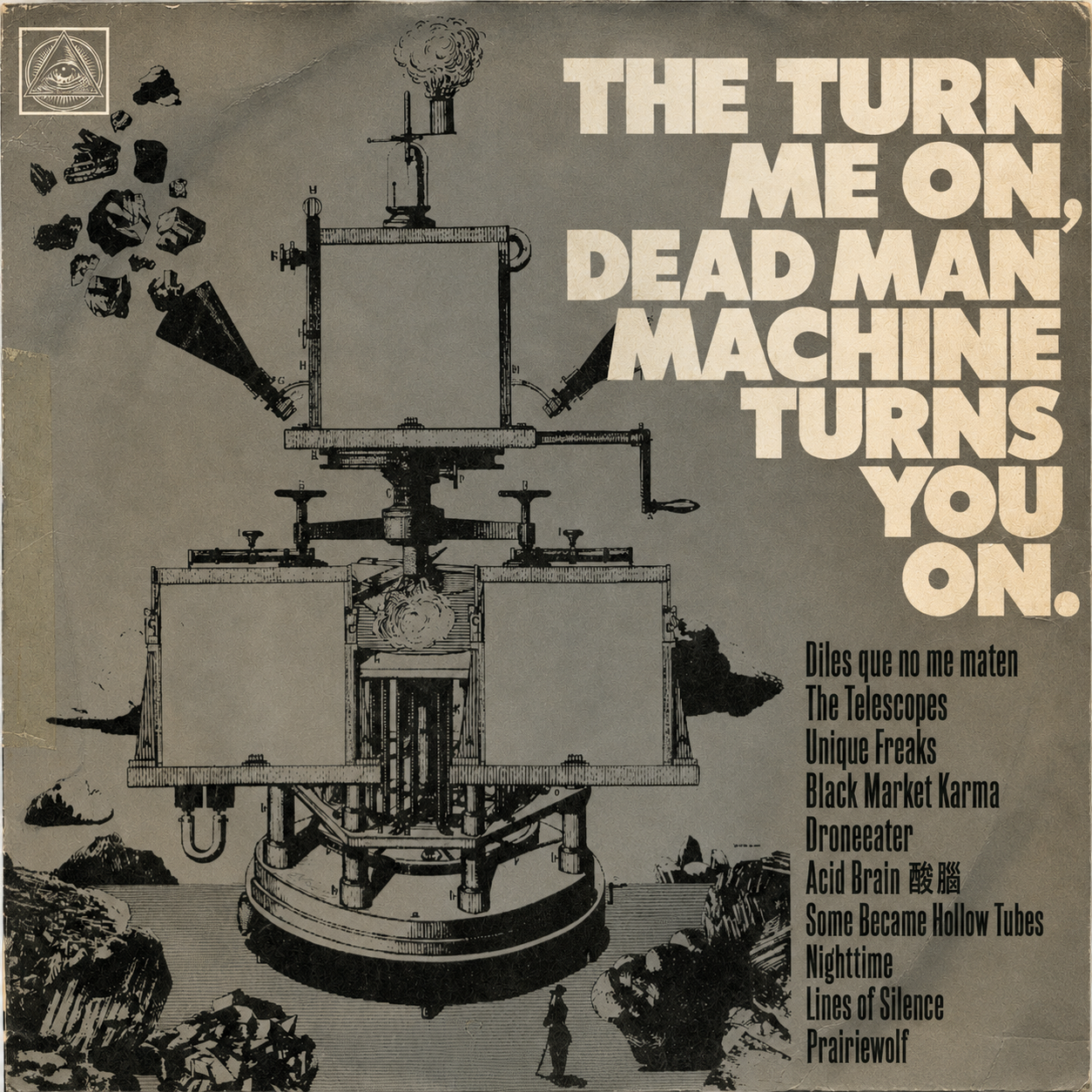
Psychedelic music for these days of Canadian wildfire haze and summer heat. Recent releases from Diles Que No Me Maten, The Telescopes, Unique Freaks, Black Market Karma, Droneeater, Acid Brain, Some Became Hollow Tubes, Nighttime, Lines of Silence, and Prairiewolf.
| Time | Artist | Track Title |
|---|---|---|
| 00:50 | Diles Que No Me Maten | Hiriku |
| 04:23 | The Telescopes | White Noise |
| 08:41 | Unique Freaks | Be Free, Your Way |
| 12:12 | Black Market Karma | Heavy Headed |
| 17:08 | Droneeater | Āhuru Mōwai |
| 21:21 | Acid Brain | Requiem |
| 29:03 | Some Became Hollow Tubes | Frozen ICE |
| 43:44 | Nighttime | Snake Eyes |
| 48:29 | Lines of Silence | Lines In Opposition |
| 53:38 | Prairiewolf | Burning Edges |
2026
Banda independiente de la Ciudad de México.
Jonás A.D.C: Voz, Guitarra, Saxofón Alto, Armónica
Jerónimo García Elizondo: Guitarra, Clarinete, Arreglo de vientos
Andrés Lupone: Bajo, Mellotron, Arreglo de vientos y cuerdas
Gerardo Ponce Ramirez: Guitarra, Sintetizador
Raúl Ponce Ramirez: Batería, Percusiones
Alain Derbéz: Saxofón Soprano
TMODM: “Hiriku” is built around an excerpt from José Vicente Anaya’s poetry, with its images of divided identity and the search for a “true name.” What was it about that poem that made you feel it needed to become music, and how did it shape the sound of the track?
Diles Que No Me Maten: José Vicente is a great poet. “Híkuri,” the poem from which “Hiriku” was born, gave me the word I had been missing to describe a sensation. I found it there—both in “meditación de cráneo roto” and in the final chorus of “Hiriku.”
TMODM: Your music moves between psychedelic rock, krautrock, post-punk, and free improvisation. When you’re writing together, do you begin with a musical idea or an image, or do you discover the songs through improvisation?
Diles Que No Me Maten: I guess I can now say that the sensation in both “meditación de cráneo roto” and the final chorus of “Hiriku” is about being yourself while also being something else, like the “I and I” of the Rastaman.
TMODM: Your Bandcamp page describes the project as “meditación de cráneo roto.” What does it mean to you, and how does that idea connect the music you’re making with the experience you hope listeners will have?
Diles Que No Me Maten: I have no idea, actually.

Though vaguely considered along the lines of noise, space rock, dream pop and psychedelic, The Telescopes have consistently expanded boundaries, colouring outside the lines with possibility. This house has many rooms, embraced across genres, influential to many, all embracing, in an orbit of its own.
Static Charge is The Telescopes’ 19th studio album since the group’s inception in 1988 – and their 7th release on Tapete Records.
TMODM: You’ve described “White Noise” as being about people whose words hide a “rotten agenda.” What inspired that theme, and why did it feel like the right way to open Static Charge?
Stephen Lawrie: You only have to look up from whatever you are doing to get a pretty accurate idea of what inspired the theme of that song. It’s all around us.
I think that, in any social engagement, it’s beneficial to make the right introduction. It saves time later.
TMODM: You recorded most of Static Charge live and with very few overdubs. What did that approach preserve in “White Noise” that might have been lost through a more carefully constructed studio process?
Stephen Lawrie: Working this way is a very carefully constructed studio process. There are so many things to think about all at once, especially when writing as you go along.
However you record, that is what you capture and preserve. This is the sound of four people in a room having a conversation with each other through their instruments. That is how it was recorded, so that is what was preserved.
TMODM: You’ve described Static Charge as carrying an “unsaid feeling” and reflecting the strange times we’re living through without becoming explicitly topical. How do you translate that kind of unease into sound without explaining it too directly in the lyrics?
Stephen Lawrie: By taking it by the roots. Reaching beyond the situation. Finding a simplistic release that speaks of the complexities and makes you feel better.
Experimental Psych Rock duo from Dublin Ireland; formed in 2019. consisting of Darragh Hansard & Elizabeth Doyle AKA Thee U.F.O, United Freedom Operation, Unique Freak Operation
TMODM: When you explained the name change from Thee UFO to Unique Freaks to me in 2024, you mentioned that U.F.O. had stood for different things over the years, including “United Freedom Organisation.” Now here’s a song literally titled “Be Free, Your Way.” Last time we spoke, you said that “Unique Freaks” felt like the right name for where the band was heading. Now that you’ve had some time to live with that identity, what does Unique Freaks allow you to do creatively that Thee UFO didn’t?
Unique Freaks: I think we’re getting more and more comfortable doing whatever we want and seeing an idea through that we probably never would have before. That might be hard to believe, considering we’ve released an eclectic bunch of music over the years, haha.
Now the main idea is that we bring an idea to its wits’ end, regardless of genre, and then add elements that are our kind of “calling cards.”
TMODM: “Be Free, Your Way” has an unusually positive, almost encouraging message compared with some of your earlier work. Was that optimism something you consciously wanted to explore, or did it simply emerge from where you were at the time?
Unique Freaks: We brought a lot of optimism to Enjoyment Planted, but there was a yin to the yang on that album. Every positive message had its counterpart.
I think with “Be Free, Your Way,” the message is just a little more obvious. I had a habit throughout all our releases of bringing anything optimistic or positive back down to earth somehow. Now I’m happy enough to let optimism take centre stage.
TMODM: You’ve always had a knack for writing songs that sound immediate and spontaneous, even though they’re carefully crafted. When you know a song is finished, what are you listening for? Is it that moment when adding anything else would actually make it less effective?
Unique Freaks: Well, thank you! I’m not sure I know when a song is finished. I just throw as much as I can at the wall, and after that I’m just hoping it sounds good, haha.
I’m very much of the mind that you should record every idea you think will contribute to the song, and if it doesn’t, mute it. Also, record every idea in general!

Black Market Karma are psychedelic group, hailing from London and now residing on the South coast of England. They have 11 albums, all written and produced by band leader and multi-instrumentalist Stanley Belton. They have collaborated with Sonic Boom (Spacemen 3) The Telescopes, Les Big Byrd, The Underground Youth and toured with The Black Angels and The Warlocks.
TMODM: Black Market Karma has often been described as a studio-driven project. When you took songs like “Heavy Headed” to the Fuzz Club Festival stage, what aspects of the music changed naturally in a live setting, and what were you determined to preserve from the studio versions?
Black Market Karma: The goal is to achieve the feeling of the song rather than worry about performing exactly the same arrangement live as on the studio recording, although we’re a six-piece now, so we can—and do—take that approach with a number of the tracks.
The outro lead part is different live from the original release. I added some new melodies over time and eventually went back and recorded them onto the studio version as a “remix.”
It appears on our album An Introduction to Black Market Karma & Their Technicolour Liquid Audio Machine.
TMODM: This is your first official live album, and the set draws heavily from Wobble and Mellowmaker. Looking back on that performance now, do you see it as a snapshot of a particular era of Black Market Karma?
Black Market Karma: Since those albums came out on Fuzz Club, it made sense to me to build a set that revolved heavily around them for the festival. Only two of the songs are from the back catalogue.
I suppose it’s hard to see something as an era when you’re still in it. Give it a few years and maybe it will feel that way. Things are always changing.
TMODM: You’ve been exploring psychedelic music for many years, but your records never feel nostalgic. What do you think still excites you about psychedelia, and where do you think Black Market Karma can still take it?
Black Market Karma: I genuinely adore music, and it affects me in a way that nothing else does. I listen to a lot of different kinds of things too.
I think the key is never to feel as though you’ve arrived at some place. I’m always pushing to find the next idea and get it recorded. You have to stay in touch with that sense of wonder we have as children and hold on to it, I think. As long as you’re always learning, it’ll work out.

Droneeater is from Nelson, New Zealand. Drone inspired music channeling mātauranga Māori.
TMODM: You describe your music as “drone-inspired music channeling mātauranga Māori.” How did you arrive at that combination, and how do you approach bringing traditional music and contemporary experimental sound together without one overshadowing the other?
Droneeater: Traditional Māori music—which is to say old Māori music, as opposed to acoustic guitar-driven music born after colonisation and coming of age during the world wars—has long featured drone and microtonal elements. Māori was an oral culture, and thus our tribal stories, whakapapa (genealogies), and poetry were expressed and remembered through chanting. This often took the form of one or more people singing in a near-monotonous drone, occasionally moving up or down around the minor third.
This was all relatively unknown to me as I was growing up. Like many people with Māori ancestors, my Māori heritage was not celebrated, and thus I did not have the privilege at that time of learning the beauty of our deep cultural knowledge.
I played music, however, and stumbled across Middle Eastern and Asian drone music while playing in various bands. This coincided with a national renaissance in Māori knowledge, and so I began to rediscover my Māori heritage and our language, and saw a space to explore the drone. I find it a very powerful vehicle for setting a meditative vibe and, consequently, well suited to psychedelic rock and dance music.
I think that if I’m authentic and open-minded in how I explore and present the different influences, they will blend rather than overshadow one another. I’m certainly not the first to explore te reo Māori—the Māori language—in new contexts, and I owe a lot to those who carved the path I’m on.
TMODM: How do you decide whether a particular song calls for a more acoustic, meditative approach or a more electronic one?
Droneeater: With the way songwriting currently works for me, relevant songs are born while I’m working in a particular context—frequently playing or working on electronic dance material, or preparing for a tour with my band and therefore playing more guitar and keys.
Our band Suena Oro, a te reo Māori/Spanish experimental fusion band, is touring at the moment, so I’m playing a lot of our original material. More songs are being drawn forth through jamming, or come to me later in the form of lyrics, a melody, or a riff.
Having said that, I think there are themes and philosophies that join all my musical worlds together: open-ended experimentation, support for the revitalisation of te reo Māori, music as a vehicle for political messaging, music that invites bodily movement, and music that invokes thought and emotion.
TMODM: You’ve highlighted Ngā Oro Rōria through Nelson Techno Collective’s platform. What is your relationship with Nelson Techno Collective, and how has that community influenced your work as Droneeater?
Droneeater: Nelson Techno Collective is a record label and promoter crew based in the town where I live, Whakatū/Nelson, Aotearoa/New Zealand. They are well regarded for the dank dance-music parties they host and the phat artists they bring to our relatively small town. They are, and invite, great DJs and producers.
Their love of faster-BPM music directly inspired me to produce what became the single from my debut Droneeater release, “Tō Wairua,” at 135 BPM. Droneeater material tends to be slower and more “plodding.”
However, it is my friendship with one of NTC’s founders, Alvaro Moreno, that has really been the source of inspiration. Somehow, a very warm, organic sense of creation arises when we play music together—at least, it feels that way to me.
We both have children and started sharing original music that we had written for them. This project then morphed into the band I mentioned above, Suena Oro, which features Indigenous Māori instrumentation, experimentation, and humanist lyrical content in folk, reggae, world, and psychedelic contexts.

Shawn Lee 李想 – acoustic guitar, electric guitar, flute, tin whistle, bass, synthesizer, samples, piano, strings, vocals (tracks 1–9)
Eric Lai 賴慶禧 – electric guitar (tracks 2, 4, 6, 7, 8, 9); synthesizer (track 5)
Chiayu Hsu 徐嘉佑 – electric guitar, acoustic guitar, synthesizer, samples, vocals (tracks 2, 3, 4, 6, 7, 8, 9)
Yilin Tsai 蔡易霖 – bass, vocals (tracks 2, 4, 6, 7, 8, 9)
Isaac Jiang 江以撒 – drums, percussion (tracks 1–9)
TMODM: The title Heptaméron feels like it points to something larger than just a collection of songs. What idea or thread ties the album together for you, and how did that shape the writing?
Acid Brain: There are seven days in a week, and these seven days resemble an endless, recurring nightmare—a continuous bad trip. We used this premise to build the album’s concept, mapping it onto the tracks we had already written while using it to finish the rest of the storyline.
Halfway through the writing process, we mapped out a complete narrative for the entire album. Ultimately, the storyline and the music influenced each other reciprocally, shaping the final piece into what it is today.
TMODM: Heptaméron was recorded on your own terms, in bedrooms and rehearsal rooms. How did that way of recording shape the sound of the album?
Acid Brain: We chose to disregard many traditional rules, from the standard practice of “going into a professional studio” to the strict pursuit of pure analog recording favored by many bands in similar genres. Instead, we utilized every available resource and threw everything we had at it, using any means necessary to achieve the exact sound we envisioned—which many would describe as a Gen Z band aesthetic.
We also refused to let live-performance limitations hold us back, uninhibitedly layering our tracks with wild ideas, whether it was stacking more and more guitars or injecting various electronic sound effects.
TMODM: Acid Brain is described as a very young band, with an average age of 21, but Heptaméron already feels ambitious and wide-ranging. What kind of music were you all bonding over when the band first came together, and where do you feel Acid Brain is headed after this debut?
Acid Brain: When we first started, we bonded over space-psychedelic rock like Slift before discovering bands like King Gizzard & the Lizard Wizard and Psychedelic Porn Crumpets, who infuse psych-rock with metal elements. Eventually, we were heavily influenced by various stoner-metal bands.
This foundation merged with the diverse personal tastes of our members, which span from post-rock like Godspeed You! Black Emperor to electronic music and traditional Irish music.
Moving forward, we want to write more boundary-pushing music. Someone commented under our album that it “leaves me craving more music that combines these specific elements in these specific ways.” We will continue to deliver entirely new works to everyone, done strictly our own way.


Some Became Hollow Tubes from Montreal, Québec. Improvised drone rock waves from Eric Quach (thisquietarmy - relentless DIY powerhouse) and Aidan Girt (Godspeed You! Black Emperor). Chords loop, pedals get pushed, pounding drum parts get added and subtracted, it starts quiet and gets loud. Eric no longer needs to worry about the rhythm, Aidan no longer has to worry about the song structure.
TMODM: “Frozen ICE” appears on a tracklist alongside titles like “Killing a Dead Eagle” and “They Don’t Need a Reason to Kill You,” making the album’s commentary on U.S. immigration enforcement fairly unmistakable. Did the music for that track exist before you gave it that title, or did the title come first and shape how you mixed it?
Some Became Hollow Tubes: In short, we are constantly digging into our backlog of material recorded over the years and mixing it with the intention of making an album from the chosen tracks. These particular tracks were jammed and recorded quite a while ago.
However, to complete the process of making an album and to have closure, we make sense of the tracks within the current state of the world and provide context in that way, once we are satisfied with the music as a finished album.
TMODM: How do you balance spontaneous performance with shaping something that feels like a complete statement?
Some Became Hollow Tubes: The spontaneous intention of a raw improvisational purge comes first, and this is probably very specific to each of us individually at the time of the performance. Then there is the process of stepping back and understanding the work while mixing the tracks.
We also set up to record almost every time we get together for a jam. That goes a long way toward giving us a vast amount of material to choose from and work with afterward.
TMODM: You come together from different musical backgrounds—Eric from thisquietarmy and Aidan from Godspeed You! Black Emperor—and yet the project feels very unified. What does each of you bring to the collaboration, and how does that interplay drive the sound of the band?
Some Became Hollow Tubes: I think that, for Aidan, it allows him to be much freer than he is in the Godspeed context. I believe that is what he likes about the project.
It is a very open collaboration, so anything goes and anything can happen. It is like a dialogue between us, with a lot of push and pull and reactions to each other’s playing. That makes it very fun and more enjoyable than conventional composition, where song structures have to be predetermined for maximum impact.
Here, the impact of our interplay comes from all the surprises and mistakes that happen along the way, up to the point of reaching a resolution.
For me, Aidan is really fun to play with. The impact of his drumming on my sound is huge, in the sense that he pushes me to perform and be creative in a way that I am not when I am working solo.
There is also an improvisational-duo synergy that can be anxiety-inducing and stressful, but it really gets me out of my usual element.
A gift for lovers of 60s folk and crystalline, song-y psychedelia, Nighttime aka Eva Louise Goodman, delivers fluent, buoyant compositions that run the gamut of psych-pop, girl group, and Americana. Nighttime's third full length album, Keeper Is The Heart, engineered and co-produced by Florist's Rick Spataro, was released on Ba Da Bing! Records in 2023. Lauded by Bandcamp as Best New Music, they called the record “a mystical tapestry of psychedelic folk.” Nighttime reaches deep into the essence of musicians such as Vashti Bunyan, Sibylle Baier and Pentangle, breaking down the decades into a sound thoroughly and bizarrely modern.
TMODM: “Snake Eyes” has that line about “rolling the cosmic dice,” which seems to fit the larger feeling of Looking Glass as an album about stepping into the unknown. What did that image mean to you when you were writing the song?
Nighttime: I’ve always been drawn to dice and games of chance or luck. I remember playing “Pumpkin Yahtzee” every year as a child at the Halloween fair at my elementary school and dying to see matching images on the dice.
I think that, as time goes on, the concept of “winning” or “success” becomes less black and white, and can even become something quite intimidating. I think this song is about that mixed feeling, where you’ve stopped holding yourself back: you’ve taken a chance, and now you must face it.
TMODM: Your About page describes Nighttime as moving between near-medieval folk purity and 1960s-flavored rock. How does that balance show up in the writing on Looking Glass?
Nighttime: I think the record melds different eras in a few ways. I’m into simple chord progressions and melody, but I also love bringing in collaborators and letting them improvise. There’s electric guitar and bass, but also harp, flute, and horns.
I try to lean into the fact that the past is inspiring and the 1960s produced very cool music, but we have a whole world of inspiration and technology at our disposal that couldn’t have been dreamed of back then!
TMODM: Nighttime began more as a solo recording project, but Looking Glass brings in a wide circle of musicians and collaborators. How did opening the project up to more people change the sound or spirit of these songs?
Nighttime: The possibilities for arrangement have totally evolved since I began collaborating with more musicians. For a long time, I would have only guitar and strings on my recordings, with occasional bass, flute, or light percussion as well. Now there are so many more textures and so much more personality present in the songs. The project just feels more alive.
I recorded my 2023 album, Keeper Is the Heart, by myself during lockdown, and I was honestly just depressed when I sat down with the results. It felt heavy and kind of... solitary. When I re-recorded the music with friends, the whole energy changed. I think what goes in is what comes out.

Lines of Silence are an experimental krautrock / kosmische band from the stranger reaches of North West England.
TMODM: Your earlier work explored long-form ambient soundscapes, while this new album feels more song-oriented and introduces vocals for the first time. What led to that shift, and did adding a voice change the way you think about composition?
Lines of Silence: Yes, you’re right. Lines of Silence is a continually evolving project that originated with me wanting to focus on longer-form meditative pieces rather than more structured tracks. That side of things still makes itself known in some of what we do, but it tends to be a bit more concise. The track “A Life Examined” from the new album is an example of that.
I never want to repeat myself, and as someone who identifies as having ADHD, I suspect that may be behind the restlessness and desire to try different things. “Lines in Opposition!” is our most traditional song-based track. Andrea has been playing with the band for a couple of years, and I wanted to make use of her vocal talents to take things in a different direction.
Once you have something based around a more traditional verse-chorus structure, it does encourage you to think differently about composition and arrangement. But we also used more abstract vocals on “Transcendental Radiation,” which was influenced by the way Seefeel use vocal samples rather than voiced lyrics.
I’m currently working on new material with me singing, so I’ve definitely become more interested in how the voice can be part of what we do while remaining principally an instrumental band.
TMODM: You’ve said the title “Lines in Opposition!” nods in two directions at once—opposition to the far right and a reference to the Rock in Opposition movement of Henry Cow and Faust. You’ve also called the track “a cry of anger against the grifters, wannabe authoritarians and grievance mongers that try to divide us, and a call for unity and transcendence.” In making this political statement, did the words come first, or did they flow from the groove?
Lines of Silence: Hmm, good question. I think I wrote a first pass of the lyrics first—something I find quite difficult—and then passed them to Andrea, who developed them and added an additional verse.
But I must have had the track hanging around in instrumental form, as I recall editing parts of a demo that Andrea recorded into it to create the structure we ended up with. I must have shared the track with her too.
I’ve always been very interested in and engaged with politics from a left-wing perspective, and there is a lot to be very concerned about right now. But I never really wanted to write an overt protest song. Music has always been an escape for me. But that’s what came out!
As for the Rock in Opposition movement, I love those bands, but we could never match them in terms of technical competence!
TMODM: You describe Lines of Silence as an experimental kosmische band, but your music also draws from drone, post-punk, electronica, and psychedelia. Is genre something you consciously try to escape, or do you simply follow wherever a piece of music wants to go?
Lines of Silence: Yes! Everything I write is an expression of my “musical DNA,” if you like, but I’ve always had eclectic tastes. The kosmische influence is definitely there, not just in the sound but also in the anarchic attitude of those 1970s German groups.
I think genre and specific genre tropes can be very limiting and a bit of a straitjacket, so I try to escape them as much as possible. There’s no point in simply recreating past sounds. I like taking parts of my influences, recombining them, and remaining open to new sounds and approaches.
We have a big dub influence too—not in the sense of dub reggae, although I love that, but in the approaches and studio techniques those producers used. I suppose my ultimate aim is to create psychedelic music and explore different ways of doing that.
To answer your last question about following wherever a piece of music wants to go: yes, absolutely. I’d say that 95 percent of the time, the finished track is very different from what I started with.
I’m not very conceptual in how I approach making music. I’m more interested in the sound, flow, and dynamics, and in how those things make you feel. I like the idea of meaning arising from that in a way that is personal to the listener.
The album title, Lines in Opposition!, is also a nod to being outside a scene or genre.

Spiritual instrumentals mined at 8000ft. Soaked in Sandy Bull, Alice Coltrane and Tangerine Dream. Featuring Stefan Beck (guitar & steel), Tyler Wilcox (bass), Jeremy Erwin (keys & synth), and the Ace Tone Rhythm Ace.
TMODM: When you’re writing and arranging, how do you decide what should stay fixed on the record and what should remain flexible for the live setting?
Prairiewolf: The three of us tend to write in a way that encourages just about any aspect of a tune to be stretched and explored, though bridges and choruses remain fairly fixed once we’ve settled on an arrangement. They’re almost like a muster point where we gather our bearings and sync up before heading back out into the wild.
TMODM: Given how much “Burning Edges” apparently morphed from night to night throughout 2025, what does the version on Zone Poems represent? Is it the take you’d call definitive, or simply the one that worked best once you started layering tape on tape?
Prairiewolf: It’s more of a “fantasy version” than a definitive one. The long synth intro is sliced from a particularly heady studio experiment, while the body of the song is based around a live version from October 13, 2025, where Stefan played an atypically extended solo—not something you’re likely to hear at a Prairiewolf show.
Spliced together, they create a sort of alternate-universe version of the tune that we likely won’t try to recreate. One of one.
TMODM: You make so many live recordings available through the Internet Archive. What does that openness mean to you, and how does knowing the shows are being preserved affect the way the music evolves from night to night?
Prairiewolf: We’re not much of a touring band, so sharing those recordings is our way of making up for that. The practice also keeps us honest in our desire to make every performance unique.
Knowing that someone could easily listen to multiple versions of, say, “The Cold Curve” is a serious incentive to push that song into new territory every time we play it.